
Who looks after your home when you're away? Home watch services in Mexico

Your home in Mexico can be looked after by a home watch provider, a caretaker, a property manager, or a house sitter, depending on the tasks you need covered. A condo administrator may handle shared areas without checking inside your unit. The useful arrangement names who inspects the home, coordinates repairs, holds access, reports problems, and acts when you cannot be reached.
Table of Contents
- Which care arrangement fits the work your home needs?
- Who manages the inside of your condo in Mexico?
- What makes a home genuinely suitable for lock-and-leave living?
- How do you turn a promise to check the house into useful reporting?
- What happens when a repair cannot wait for your reply?
- Would a house sitter or rental use change the care plan?
- How does the choice work for a part-time owner?
- Where does The Golden Life fit before you buy?
- Frequently Asked Questions
The question is less about finding someone with keys than deciding what those keys authorize them to do. Someone who waters plants may not coordinate a repair, and someone who manages a building may have no responsibility for your refrigerator or a leak inside your condo.
For Americans considering a second home, home watch services in Mexico belong in the property decision, not just the departure routine. Start with whether the home will be empty, occupied by a sitter, or used by guests. Then match the care arrangement to the actual property and the amount of coordination you want to retain.
Which care arrangement fits the work your home needs?
Job titles are a starting point, not a service specification. For comparison, think of home watch as agreed inspection visits, a caretaker as hands-on routine care, and property management as a broader coordination role. Individual providers may combine these tasks or define them differently.
House sitting is a different choice because someone occupies the home during an agreed absence. It can suit a home with pets or plants that need regular attention, but occupancy alone does not establish repair expertise or responsibility for contractors.
The table describes possible arrangements, not verified packages or services supplied by The Golden Life. Use it to identify the kind of work you need before evaluating a local provider.
| Arrangement | Useful when | Scope to establish | Main trade-off |
|---|---|---|---|
| Home watch visits | The home will remain empty and needs agreed inspections | Interior access, inspection tasks, reports, and escalation | Visits leave gaps between observations |
| Caretaker | The property needs recurring hands-on attention | Routine tasks, attendance, materials, and repair boundaries | Specialist work may need separate contractors |
| Property manager | You want someone to coordinate multiple service providers | Inspections, contractor supervision, approvals, and records | A broad title can hide a narrow service agreement |
| House sitter | Someone will occupy the home and provide agreed daily care | Pets, plants, permitted use, absences, and handover | You share private space and still need a maintenance plan |
| Friend or neighbor | A trusted person can accept a limited, clearly defined role | Specific checks, access, availability, and backup | Goodwill may not provide dependable ongoing coverage |
Choose a coordinator when tasks depend on each other
A cleaner and a gardener can each complete their work without managing the whole home. Coordination becomes a separate job when a cleaner notices moisture, a technician needs access, and someone must document the result.
If you retain that role, expect to arrange access and follow up remotely. If another person takes it on, establish what they can arrange independently and what requires your approval. More visits do not necessarily solve a missing coordination role.
| Arrangement | Core role | Key limitation |
|---|---|---|
| Home watch visits | Agreed inspection visits | Gaps between observations |
| Caretaker | Hands-on routine care | Specialists may be needed |
| Property manager | Coordinate multiple service providers | Broad title may hide a narrow scope |
| House sitter | Occupancy and agreed daily care | Still needs a maintenance plan |
| Friend or neighbor | Limited, clearly defined help | Availability may limit coverage |
Who manages the inside of your condo in Mexico?
For an individual condo, start by separating shared-building responsibilities from care inside the unit. Do not assume that an administrator who organizes common-area maintenance also opens your apartment, checks appliances, or supervises your private repairs.
Request the building's written service scope and compare it with the proposed in-unit care arrangement. You are looking for both gaps and overlap: a task nobody owns is a problem, but so is paying separate providers for the same work without a reason.
Access also has to work in practice. A building may have its own procedures for visitors and contractors; the person caring for your home needs a workable way to enter under those procedures. Legal interpretation of building documents belongs with a qualified independent professional.
- Who can enter the unit when you are away?
- Who checks private fixtures, appliances, and visible signs of moisture?
- Who receives notices that affect the unit?
- Who coordinates access when a shared-building problem requires work inside?
- Who tells you that a problem has been resolved?
A staffed entrance is not evidence of an interior inspection service. Likewise, a cleaner's visit is not evidence that drains, windows, or equipment were checked unless those tasks are part of the agreement.
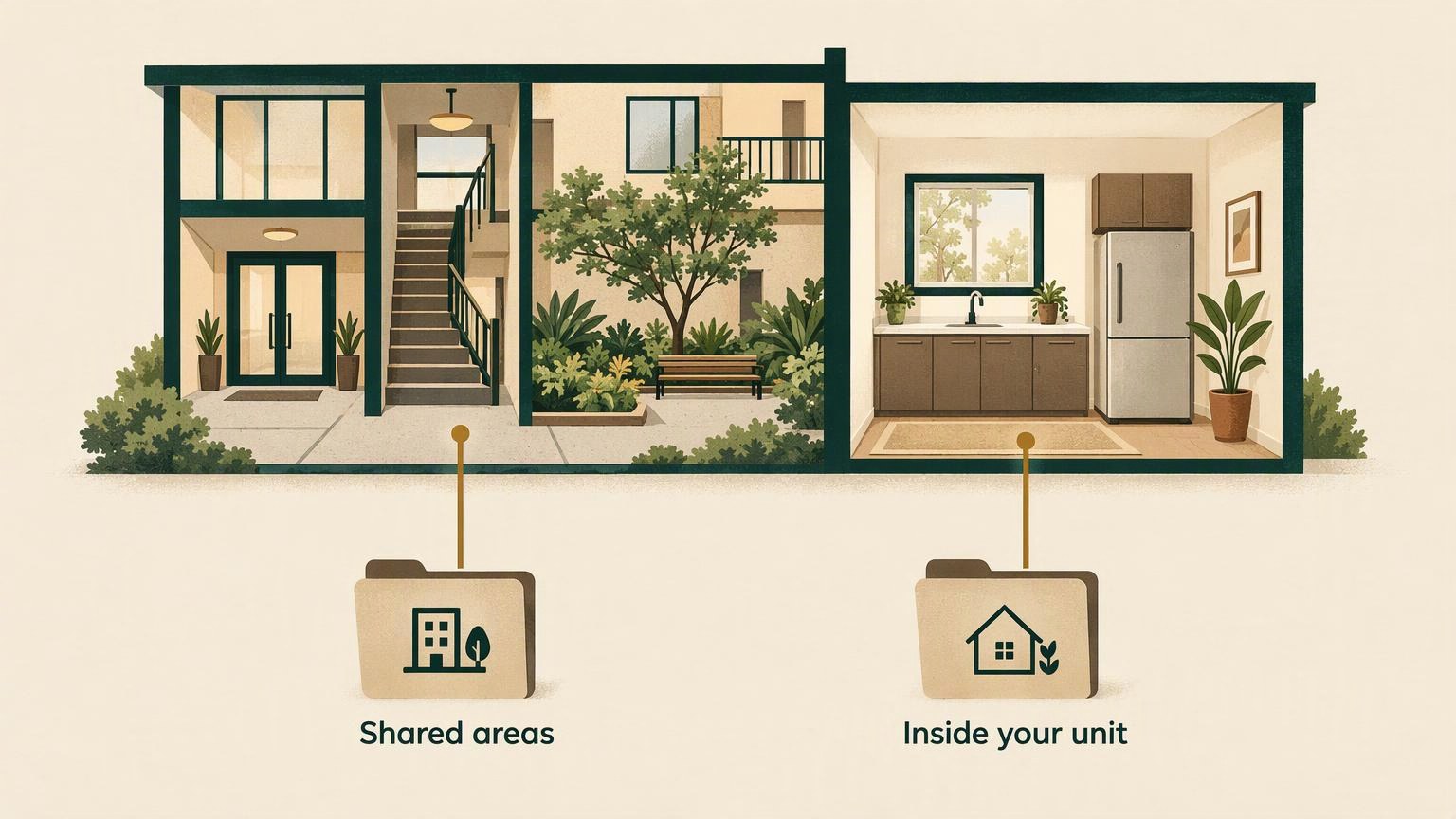
Illustration of shared areas and a private unit, separated by a green boundary and linked by gold lines to folders labeled Shared areas and Inside your unit.
What makes a home genuinely suitable for lock-and-leave living?
A lock-and-leave home in Mexico should be evaluated by how it functions during an absence, rather than by the label alone. The practical test is whether recurring work, access, and problem handling can continue without your physical presence.
Compare properties by the work attached to them. A home with a private garden, pool, or several separate maintenance systems may need more hands-on coordination than a unit with fewer private systems. That does not make either choice better; it changes the care arrangement you need.
Inside the home, ask a qualified technical professional to explain appropriate settings and maintenance for the installed equipment. Shutting everything off is not a universal departure plan, and leaving everything running is not one either.
Review the absence routine during a property visit
Walk through the home as someone responsible for it while you are elsewhere. Locate shutoffs, equipment instructions, access points, and maintenance records with the appropriate professionals. Notice which tasks require entry and which can be completed without disturbing the interior.
Then consider your own habits. If you want spontaneous trips and little remote coordination, a property that depends on you to organize every small task may be a poor fit. A more demanding home can still work if you accept that responsibility or arrange suitable help.
The Golden Life's Living Well in Mexico lifestyle guide can help frame the broader decision around everyday life. The away-from-home routine is part of that life, even when the property is empty.
How do you turn a promise to check the house into useful reporting?
An inspection arrangement needs an observable output. A message saying that everything looks fine tells you little about which rooms were entered, what was checked, or whether a previous issue remains open.
Agree on a property-specific visit record. It can identify the visit date, completed tasks, observations, photographs where appropriate, and anything needing a decision. A visible check should not be represented as a technical assessment.
- Record accessible areas visited and any area that could not be inspected.
- Describe visible changes, such as moisture marks or an equipment warning.
- Separate routine tasks completed from repairs merely requested.
- Track open issues until someone documents the outcome.
Reporting also needs a rhythm. Decide when routine updates are sent and which observations trigger an immediate message. The appropriate visit frequency depends on the home and its needs; a qualified technical professional can help identify relevant maintenance concerns.
Keep photographs focused on the agreed task. Private documents and personal belongings do not need to appear in routine reports. Establish how reports, access information, and contractor records will be stored and shared.
A useful test before a long absence is to review an actual agreed visit report while you are still available to clarify expectations. If it leaves you asking what was inspected, revise the scope rather than accepting more reassuring language.

Illustration of inspection reporting: abstract record entries and three issue cards connect by gold lines to window and wall-stain images on a tablet.
What happens when a repair cannot wait for your reply?
The person who notices a problem and the person authorized to respond may be different. An away-from-home plan should connect them before you leave, including what happens when your usual contact is unavailable.
Set out an escalation path: who receives the first report, who can arrange a qualified contractor, and who provides backup if you cannot be reached. For legal questions about authority or service agreements, use a qualified independent professional.
Separate arranging work from approving payment. Discuss the kinds of routine work that require advance approval and how urgent intervention would be handled. Do not rely on an informal understanding that someone will simply take care of everything.
Prepare a handover file, then walk through it
A practical handover file includes the agreed scope, access arrangements, equipment instructions, relevant service contacts, and an issue log. Keep sensitive credentials separate from a broadly shared household document.
Walk through the file with the person taking responsibility. Have them explain how they would report an unexpected problem and get help if they were unavailable. A written plan is more useful when the people named in it understand their roles.
For insurance questions, ask an appropriately qualified insurance professional how the proposed absence, occupancy, inspections, and documentation relate to the specific policy. Do not assume that hiring a sitter or installing a device changes coverage.
Would a house sitter or rental use change the care plan?
A sitter changes who is present, but not necessarily who maintains the home. Establish pet routines, plant care, permitted use of rooms and equipment, visitor expectations, and what the sitter does when something stops working.
Talk through time away from the house as well. A person staying there may leave for errands or outings; if a pet needs a particular routine, discuss it directly and consult an appropriate veterinary professional for care questions. Do not treat house sitting as continuous attendance unless that is expressly agreed.
Rental use introduces a separate permission question. Short-term rental rules in Mexico need property-specific and current local review, rather than a nationwide assumption. A qualified independent legal professional can review applicable requirements and building documents; a qualified tax professional can address tax questions.
Operationally, guests also change the handover: keys, arrival instructions, cleaning, reporting damage, and returning the home to an agreed condition all need an owner. Neither a rental arrangement nor a sitter replaces technical maintenance.
If the home is intended only for personal use, there is no need to add guest turnover duties to a care agreement. Keep the plan matched to actual use rather than paying for or relying on an undefined rental-management package.
How does the choice work for a part-time owner?
Say you are considering a condo in Mexico for personal visits, will leave it empty between stays, and do not have pets there. You are comfortable authorizing repairs remotely but do not want to arrange every contractor's entry yourself.
A house sitter would add occupancy you do not need. Asking a neighbor for occasional help might cover a small favor, but it would leave contractor coordination dependent on their availability. Agreed home watch visits with a defined coordination role could fit better, provided the actual service covers both tasks.
Now picture the same owner choosing a house with a private garden and recurring equipment maintenance. Inspection visits alone would identify work without necessarily completing it. A caretaker plus specialist contractors, or a manager who coordinates them, becomes a more relevant comparison.
The choice follows from the work and who owns it. It does not follow from a provider calling the property easy to maintain or calling the service full management.
Where does The Golden Life fit before you buy?
The Golden Life provides destination and property guidance for Americans considering Mexico. Its process begins with your objective, then moves through relevant property information, questions and professional referrals, and an in-person visit with independent due diligence before a decision.
For a second-home buyer, that means treating time away as a selection criterion. Your intended use, willingness to coordinate maintenance, and preference for a house or condo help define what a suitable property would need to support. This is planning guidance, not a home watch or property-management service.
For the broader buying questions that sit alongside a care plan, read The Golden Life's property-buying guidance, Can Americans Buy Property in Mexico? Ownership structure depends on location and circumstances; transaction-specific legal and tax questions require qualified independent professionals.
The Next-Chapter Planner PDF is a downloadable planning guide. Use a separate note alongside it to record the away-from-home responsibilities you want to retain or delegate.
When you are ready to discuss your priorities, start a Find your place inquiry through The Golden Life. You can begin with everyday life, properties and communities, or a question; the inquiry opens in a separate form.