
Timeshare Exit in Mexico: How cancellation and co-ownership differ

A timeshare exit in Mexico depends on the agreement, the applicable rules, and whether the issue is recent-purchase cancellation or ending an ongoing commitment. Co-ownership adds a separate question: what ownership interest must be transferred? A successful exit needs a clear explanation of which rights end, which obligations remain, and how completion is documented. Qualified independent professionals should assess those questions for an individual contract.
Table of Contents
- What did you buy: use rights or an ownership interest?
- Recent-purchase cancellation is a timing question
- Ending an ongoing contract means defining the outcome
- Co-ownership adds governance and transfer decisions
- What makes a cancellation notice or exit record useful?
- How use preferences change the choice
- Where The Golden Life fits
- Frequently Asked Questions
The first question is not simply whether a contract can be canceled. It is whether you bought accommodation access, an ownership interest, or a combination of rights, and what you want to end. That distinction changes the meaning of a timeshare exit in Mexico.
A refund, a transfer to another person, and a release from future charges are different outcomes. The discussion below separates them so you can understand a contract review without assuming that a vacation club and a shared home follow the same rules. This is general educational information, not legal, tax, financing, or investment advice.
What did you buy: use rights or an ownership interest?
Start with the documents that create the rights, rather than the name used in a presentation. Words such as membership, fractional, residence, and co-ownership do not by themselves explain what a purchaser receives.
A vacation-use agreement concerns access to accommodation under specified rules. An ownership arrangement concerns an interest in property or an entity, with its own governing documents. Some arrangements combine elements of both, which is why a label alone cannot settle the exit question.
The comparison below identifies the different subjects a professional review needs to address. It does not classify any particular offering or establish its legal treatment.
| Product | Rights to establish | Use and cost questions | Exit question |
|---|---|---|---|
| Timeshare or vacation-use contract | Accommodation access and the agreement's duration | Reservation rules, recurring charges, and unused benefits | How cancellation, termination, or assignment affects the agreement |
| Fractional or co-ownership interest | The interest held and the documents governing it | Allocated use, shared expenses, and decision-making authority | How an interest can be transferred and which approvals apply |
| Full ownership | The ownership structure for the location and circumstances | Property expenses and any community rules | How a sale or other transfer affects separate obligations |
| Land | The interest acquired in the parcel | Permitted use, infrastructure, and any ongoing obligations | How the land interest transfers and which commitments remain |
A place to stay is not necessarily a home you own
Access to a suite or villa can be useful for vacations without meeting a need for a full-time residence. A shared ownership interest can also limit personal use through scheduling and governance rules.
Americans can buy property in Mexico, but the ownership structure depends on location and circumstances, including special structures in restricted coastal and border zones. The Golden Life's explanation of property ownership for Americans in Mexico provides broader context; qualified independent legal and tax professionals are needed for a transaction.
Recent-purchase cancellation is a timing question
For a recent purchase, the central issue is whether an applicable cancellation right exists and how it must be exercised. That is different from asking an operator to accept an exit from an established agreement.
PROFECO, Mexico's consumer protection agency, is relevant to consumer-contract questions. An explanation of cancellation rights needs the applicable official rules, their date, and the facts of the transaction, rather than an assumption drawn from a sales conversation.
The timeshare cancellation period in Mexico should be assessed together with its starting event, the way days are counted, and the required notice procedure. A deadline cannot be safely understood as an isolated number.
A qualified independent Mexican legal professional can assess how current rules apply to a particular agreement. For a recent purchase, timely review matters because a notice requirement and a request for customer-service assistance may be different things.
The review needs more than the signature date
Relevant records include the signed agreement, annexes, payment receipts, any separate financing documents, and communications about cancellation. These help establish what was agreed, what was paid, and what happened afterward.
The contract may describe a notice recipient, delivery method, or address. A professional review examines those terms alongside applicable law; it does not assume that a conversation with a salesperson is equivalent to valid notice.
A claimed waiver or a statement that cancellation is impossible also requires legal assessment. Neither reassurance from a seller nor a general online answer establishes the result for an individual contract.
Ending an ongoing contract means defining the outcome
After the recent-purchase question, the focus shifts to the agreement's continuing rights and obligations. An exit proposal needs to explain what ends, what is transferred, and whether another agreement remains in place.
Giving up access is not the same outcome as recovering money. Likewise, transferring a membership is not necessarily the same outcome as obtaining a release from every payment obligation.
The terms below are useful distinctions for understanding an exit discussion. Their legal meaning and availability depend on the documents and applicable rules.
| Outcome | What it addresses | What still needs examination |
|---|---|---|
| Recent-purchase cancellation | Undoing a purchase under an applicable cancellation right | Eligibility, notice, timing, and treatment of payments |
| Contractual termination or surrender | Ending an agreement through a provision or accepted arrangement | Effective date, charges, release language, and remaining balances |
| Transfer or resale | Moving rights or an interest to another person | Permission, acceptance, transaction costs, and release of the original holder |
| Dispute-based resolution | Addressing an alleged breach or misrepresentation | Evidence, applicable procedure, available remedies, and uncertainty of outcome |
Release is a separate question from transfer
Permission to transfer answers whether rights can move to someone else. Release answers whether the original holder has been discharged from specified obligations. Those questions should not be collapsed into a single promise to handle the exit.
Separate financing makes the distinction especially important. Ending accommodation rights does not, by itself, explain what happens to a financing agreement; that document needs its own review.
Stopping payment is also not the same act as completing a cancellation or transfer. Potential consequences require individualized legal and financial assessment, rather than a general recommendation to stop or continue payments.
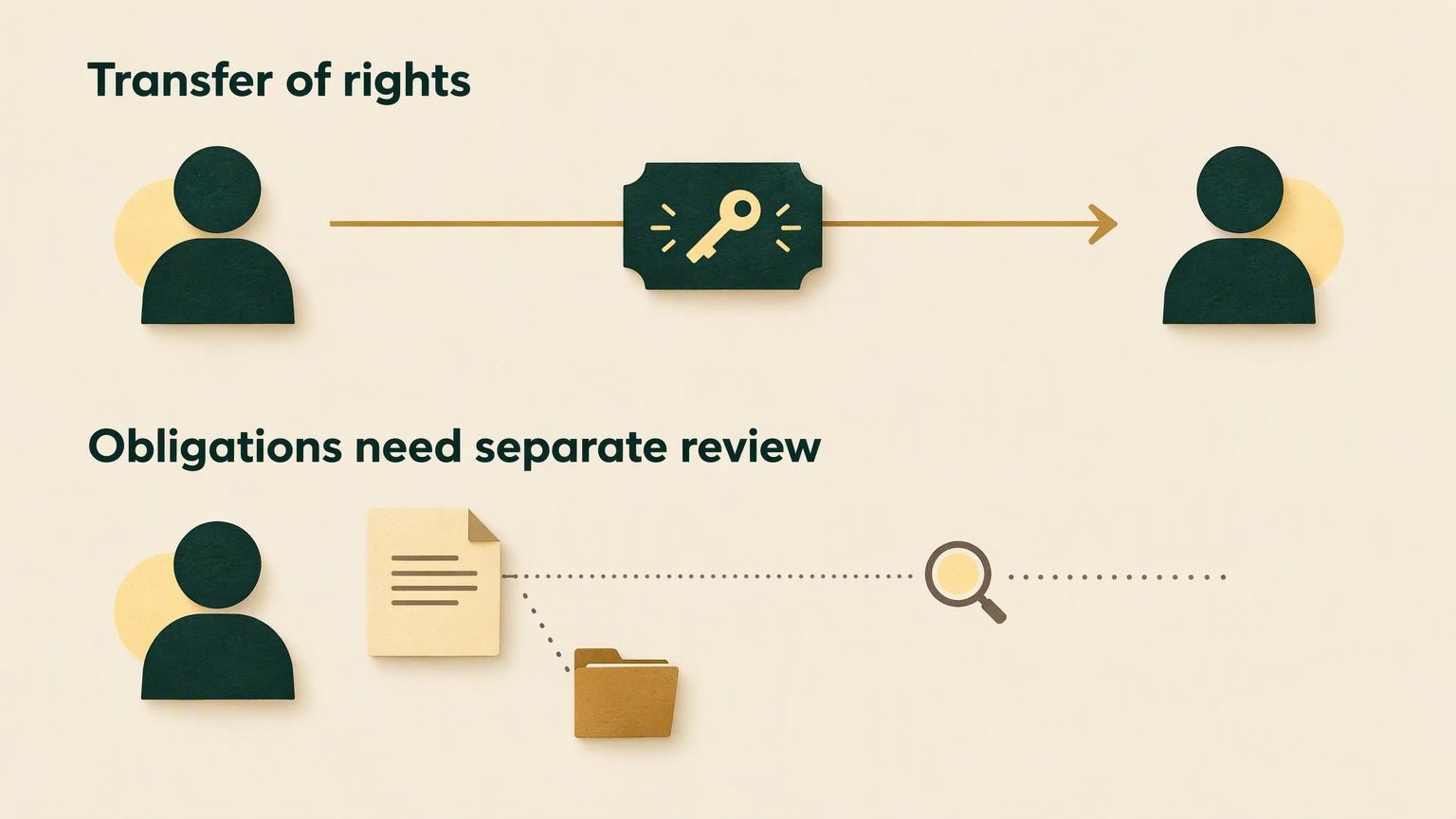
Illustration separates “Transfer of rights,” shown by a key token and arrow, from “Obligations need separate review,” shown by a document, folder and dotted lines with a magnifying glass.
Co-ownership adds governance and transfer decisions
For co-ownership homes in Mexico, the exit question concerns the interest held and the relationship among the owners. Leaving may involve more than closing a vacation account.
The governing documents need to explain who controls decisions, how use is allocated, and what happens when an owner wants to leave. A shared calendar can work well for compatible owners, but it also introduces dependencies that an independently booked stay does not have.
Ownership does not guarantee a ready buyer or a predictable resale value. The ability to transfer an interest, the demand for it, and the cost of completing a transaction are separate matters.
Permission, valuation, and expenses do different jobs
A transfer provision may address consent, an existing owner's opportunity to buy, or requirements for an incoming owner. A valuation provision addresses how a proposed price is determined. An expense provision addresses who carries costs while a transfer is pending.
These provisions can pull in different directions. A process that protects the remaining owners may reduce the departing owner's freedom to choose a buyer or complete a quick sale.
The relevant question is how those provisions interact, including when use rights and payment responsibilities change. Qualified independent professionals can assess their legal and tax implications. For broader product context, see how fractional home ownership in Mexico works.

Illustration of a wooden house model connected by gold threads to grouped owner tokens, layered papers beneath a magnifying glass and an open ledger with abstract marks; a separate token rests near the tabletop edge.
What makes a cancellation notice or exit record useful?
A useful record identifies the agreement, communicates the intended request clearly, and preserves evidence of what was sent and received. A general template cannot establish the correct recipient, delivery method, or legal wording for every contract.
For someone researching how to write a timeshare rescission letter, the distinction is between drafting content and satisfying a valid notice procedure. Qualified legal review addresses both.
The factual content commonly relevant to that review includes:
- The purchaser names and contract identifier.
- The agreement date and identification of the contracting company.
- A clear statement of the intended cancellation request.
- The payments involved and the requested written response.
- The notice, attachments, and evidence of dispatch or receipt.
A long account of an unpleasant presentation may help explain a dispute, but it serves a different purpose from identifying the agreement and communicating a cancellation request. The appropriate content depends on the legal route under review.
For a later exit, completion records matter just as much as the initial request. An acknowledgment that a message arrived is different from confirmation that an agreement ended, an interest transferred, or specified obligations were released.
How use preferences change the choice
Say you want to return to Mexico for vacations but are unsure whether you will want the same setting each year. You are comparing independently booked stays, a vacation-use contract, and an interest in a shared home.
Independently booked stays separate each accommodation decision from a long-term property commitment. Their trade-off is that future availability and terms must be assessed for each booking. A vacation-use contract may suit a repeat-stay preference, but its value depends on reservation access, ongoing charges, and the terms for ending it.
If you want to co-own a vacation home in Mexico, a shared interest may better match a desire for a recurring home base. It also brings ownership documentation, shared decisions, and transfer procedures into the picture. Those responsibilities do not disappear because the use schedule is limited.
For the person who remains unsure about returning to the same place, separate stays fit the stated preference more closely. For someone who wants a lasting home base and accepts shared governance, co-ownership deserves further examination. Neither choice can be justified by an unverified promise of easy resale.
The comparison changes again for relocation: a vacation-use product does not automatically meet a need for everyday residence. Begin with the intended use, then evaluate whether the rights support it.
| Option | Preference fit | What to assess |
|---|---|---|
| Independently booked stays | Unsure about returning to the same place | Availability and terms for each booking |
| Vacation-use contract | Repeat-stay preference | Reservation access, charges, exit terms |
| Shared home interest | Lasting home base with shared governance | Ownership documents and transfer rules |
Where The Golden Life fits
The Golden Life begins with your objective: retirement, relocation, a second home, investment, or rental use. That helps separate a lifestyle decision from a contract-resolution problem.
The Mexico Property Collection is a place to explore communities and developments, not a substitute for independent due diligence. Exploring a property type should not be treated as confirmation of availability, legal rights, or an exit policy.
If your question concerns the life or property type you want next, Find your place lets you choose everyday life, properties and communities, or a question, then send an inquiry through a separate form. It is not a cancellation filing or a promise to resolve an existing contract.