
The real cost of owning a home in Mexico, including the CFE DAC rate

The real cost of owning a home in Mexico is the purchase price plus acquisition expenses, recurring bills, maintenance, major replacements, and eventual sale costs. Electricity deserves its own review, including whether the account uses the CFE DAC rate for high consumption. A meaningful comparison uses property-specific documents and your intended use, rather than a national average or an advertised monthly payment.
Table of Contents
- What belongs in the total ownership budget?
- Separate acquisition cash from the cost of living there
- Treat electricity and the CFE DAC rate as a separate budget decision
- Compare community fees with the work still left to the owner
- How does your intended use change the budget?
- A worked comparison: similar prices, different responsibilities
- Account for currency exposure and eventual exit
- Connect the budget to the life you want in Mexico
- Frequently Asked Questions
A home that looks affordable to purchase may require more ongoing spending than another with a higher asking price. Shared amenities, cooling habits, building condition, and periods away from Mexico can change the comparison.
The CFE DAC rate belongs in that analysis, alongside community charges and repair needs. Start by separating what it takes to acquire the home from what it takes to keep it usable. This is general educational information, not legal, tax, financing, insurance, or investment advice. Qualified independent professionals should evaluate those matters for your circumstances.
What belongs in the total ownership budget?
A useful ownership budget separates expenses by purpose and timing. A purchase deposit, a routine utility bill, and a future equipment replacement all require money, but they answer different questions about affordability.
Keep the acquisition total separate from the annual operating total. Then add a replacement reserve and consider expenses associated with an eventual sale. Otherwise, a modest monthly estimate can hide substantial cash needs outside the regular billing cycle.
The categories below are a budgeting framework, not a statement that every charge applies to every property. The relevant documents and qualified independent professionals establish the applicable items.
| Budget category | What to include | Useful evidence |
|---|---|---|
| Acquisition | Purchase balance and applicable transaction expenses | Itemized transaction estimate and purchase documents |
| Recurring obligations | Applicable property-related charges and community dues | Current statements and governing documents |
| Everyday operation | Electricity, water, communications, and routine services | Bills showing billing periods and occupancy |
| Maintenance and replacements | Routine care plus longer-lived building and equipment work | Independent inspection and dated local estimates |
| Absence or rental use | Services needed while away or accommodating guests | Written service scope and applicable permissions |
| Exit | Potential sale, administrative, and professional expenses | Property-specific estimates and professional guidance |
Distinguish spending from a reserve
A reserve is money set aside for future work, not necessarily an expense paid today. Keeping it visible prevents a home from appearing inexpensive simply because a roof, cooling system, or other major component has not yet needed replacement.
Also distinguish cash flow from economic cost. If financing applies, principal repayment affects cash available even though it differs from interest and operating expenses. A qualified financial professional can help interpret that distinction.
Separate acquisition cash from the cost of living there
The advertised price is a starting point, not a complete acquisition budget. A transaction estimate should distinguish the amount paid for the property from applicable professional, administrative, registration, and other transaction expenses.
It should also distinguish amounts already paid from amounts still payable. Counting a deposit both as an earlier payment and as an additional purchase expense overstates the total; leaving an applicable fee outside the estimate understates it.
Ownership structure depends on location and circumstances, including special structures in restricted coastal and border zones. The overview of whether Americans can buy property in Mexico provides useful context, while qualified independent legal and tax professionals should assess any transaction.
Include the transition into a usable home
Furnishing, moving belongings, setting up services, and addressing inspection findings belong in the acquisition comparison when they are relevant. A furnished property and an unfurnished property are not equivalent simply because their asking prices match.
Use written inclusions to establish what stays with the home. Appliances, equipment, and furniture should not become assumed savings before their condition and inclusion are clear.
Keep financing conditional
Financing may be available for qualified U.S. buyers through licensed providers. Eligibility, property requirements, underwriting, rates, terms, fees, and approval apply.
An ownership budget should distinguish the property comparison from any financing estimate. A payment illustration is not an approval or a complete measure of ownership cost.
Treat electricity and the CFE DAC rate as a separate budget decision
Electricity deserves more scrutiny than copying a seller's latest bill into a spreadsheet. For a home associated with the CFE high-consumption category, DAC, the account classification is part of the cost question, alongside consumption and the applicable billing period.
A useful bill review records the tariff label, electricity consumed, dates covered, and whether the home was occupied. The money paid alone cannot tell you how comparable that period is to the way you intend to live.
A low bill from an empty home is weak evidence for a year-round resident who expects to cool occupied rooms regularly. Conversely, a bill from intensive guest use may not describe a quieter second-home routine.
Compare use, not just billed amounts
Cooling equipment, the rooms used, and the hours spent at home belong in the comparison. Equipment condition and building performance also matter when translating past usage into an estimate for a different occupant.
An independent technical assessment can identify equipment and building issues that a bill does not explain. Any budget based on replacing equipment should include the replacement expense, rather than counting only a hoped-for reduction in electricity spending.
Keep tariff assumptions visible
A DAC-labeled account warrants a current, account-specific explanation from CFE before its bills are treated as a reliable forecast. Do not assume that a lower-use period establishes future classification or that a different owner's electricity experience transfers to the property.
Keep the observed bills and the estimate for your intended use in separate columns. That preserves the difference between what happened and what the budget assumes.
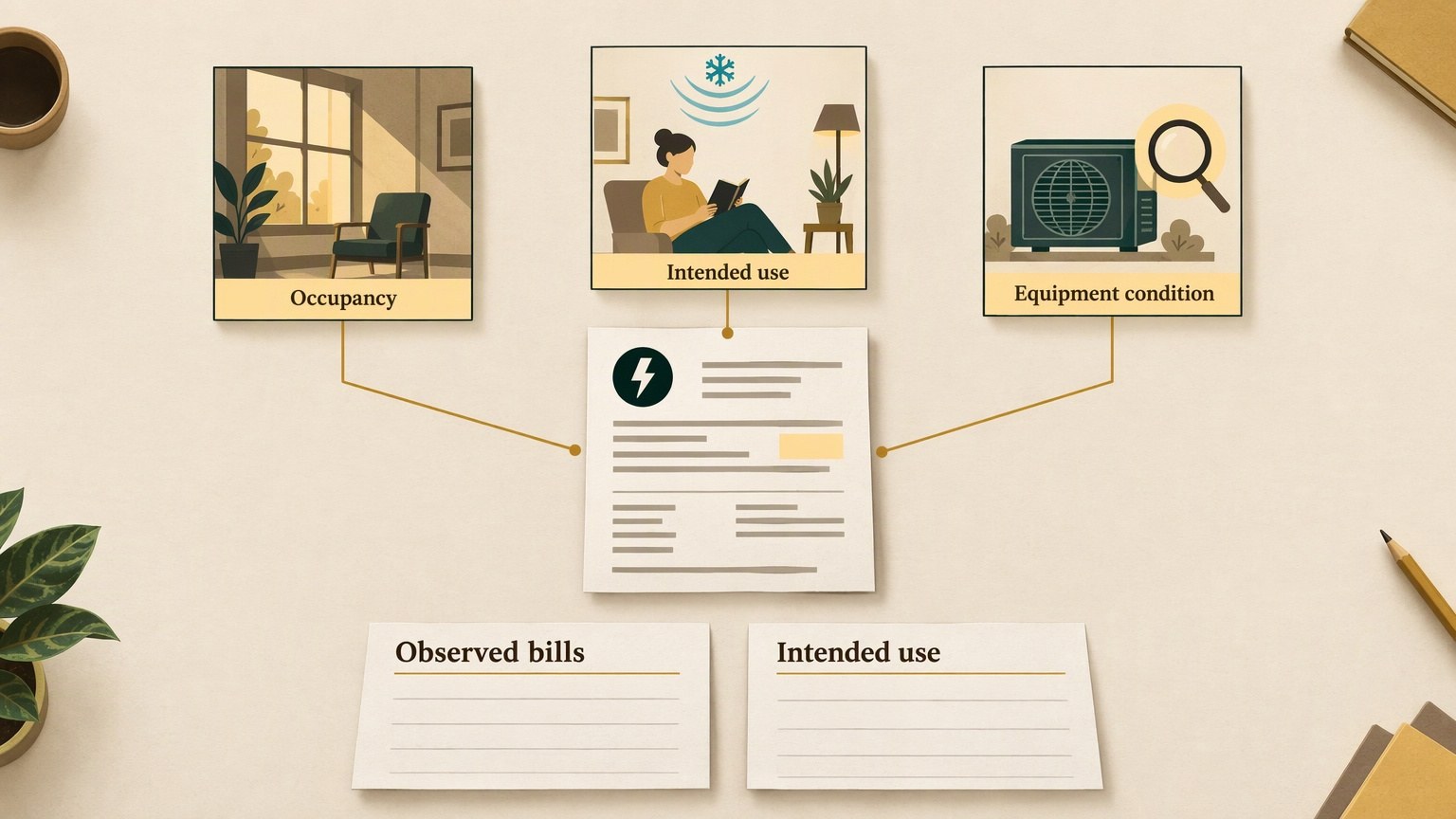
Illustration linking an electricity sheet to occupancy, intended use, and equipment condition, with separate planning sheets labeled Observed bills and Intended use.
Compare community fees with the work still left to the owner
A community fee is meaningful only alongside the services it covers. Shared maintenance can reduce the tasks an owner handles directly, but the dues themselves remain part of the ownership budget.
The comparison is not simply a condo fee versus no condo fee. It is the combined cost of shared obligations and private responsibilities, with attention to the condition of both the building and the individual home.
For a condo or managed community, useful documents include the operating budget, current dues, reserve information, and relevant meeting records. These help distinguish ordinary operations from larger work that may require separate funding.
Avoid counting a service twice
If dues include a service, do not also add a full separate allowance for the same service without explaining why. Equally, do not treat all upkeep as included merely because the property has shared management.
Interior equipment, fixtures, and finishes can still create private expenses. The governing documents establish the division of responsibility, and an independent inspection helps assess condition.
Recognize the convenience trade-off
A standalone house can provide greater control over maintenance decisions, but it can also leave the owner responsible for arranging more work. A managed property may reduce that administrative burden while requiring recurring dues and shared decisions.
Neither arrangement is automatically cheaper. The relevant comparison is the cost and responsibility attached to the specific home, not the label attached to its property type.
How does your intended use change the budget?
The same home can produce different operating needs depending on whether it is a primary residence, a second home, or used for rentals. Start with how it will actually be occupied, then identify which expenses continue during absences.
Leaving a home empty does not establish that every bill or obligation stops. A budget should distinguish usage-sensitive spending from charges and care needs that continue regardless of your presence.
| Intended use | Main budgeting emphasis | Assumption to avoid |
|---|---|---|
| Year-round residence | Regular utility use, everyday maintenance, and equipment wear | An occasionally occupied seller's bills describe full-time living |
| Second home | Continuing obligations plus care and coordination during absences | An empty home has no operating costs |
| Rental use | Permitted use, service expenses, guest-related wear, and professional review | Rental receipts will cover all ownership expenses |
Evaluate the home before counting rental income
Rental income and returns are not guaranteed. A base ownership comparison can therefore be useful without assumed rental receipts, followed by a separate analysis of any proposed rental use.
Applicable permissions, tax matters, insurance suitability, and financial assumptions require qualified independent professional review. Rental receipts should not be treated as spendable profit without accounting for the expenses associated with earning them.
| Intended use | Budget emphasis | Avoid assuming |
|---|---|---|
| Year-round residence | Utilities, routine care, equipment wear | Occasional-use bills fit full-time living |
| Second home | Ongoing obligations and care while away | An empty home has no operating costs |
| Rental use | Permissions, services, guest-related wear | Rental receipts cover all ownership costs |
A worked comparison: similar prices, different responsibilities
Say you are choosing between a condo with shared maintenance and a standalone house. You plan to spend part of the year in Mexico and want to limit the amount of repair coordination you handle while away.
For the condo, the comparison includes dues, the services included, private interior maintenance, and the community's approach to major work. For the house, it includes direct maintenance, any grounds or equipment care, and arrangements for checking the property during absences.
The condo may fit your preference if its documented services address the tasks you want to avoid and its combined costs fit your budget. The house may fit better if control matters more and the maintenance arrangements are practical for you.
Now add electricity. If the available house bills cover limited occupancy but the condo bills reflect regular use, their billed amounts are not directly comparable. The missing occupancy context matters more than which bill looks smaller.
The choice follows from the full cost and responsibility comparison. A lower asking price can remain attractive, but only after the remaining work and operating assumptions are included.
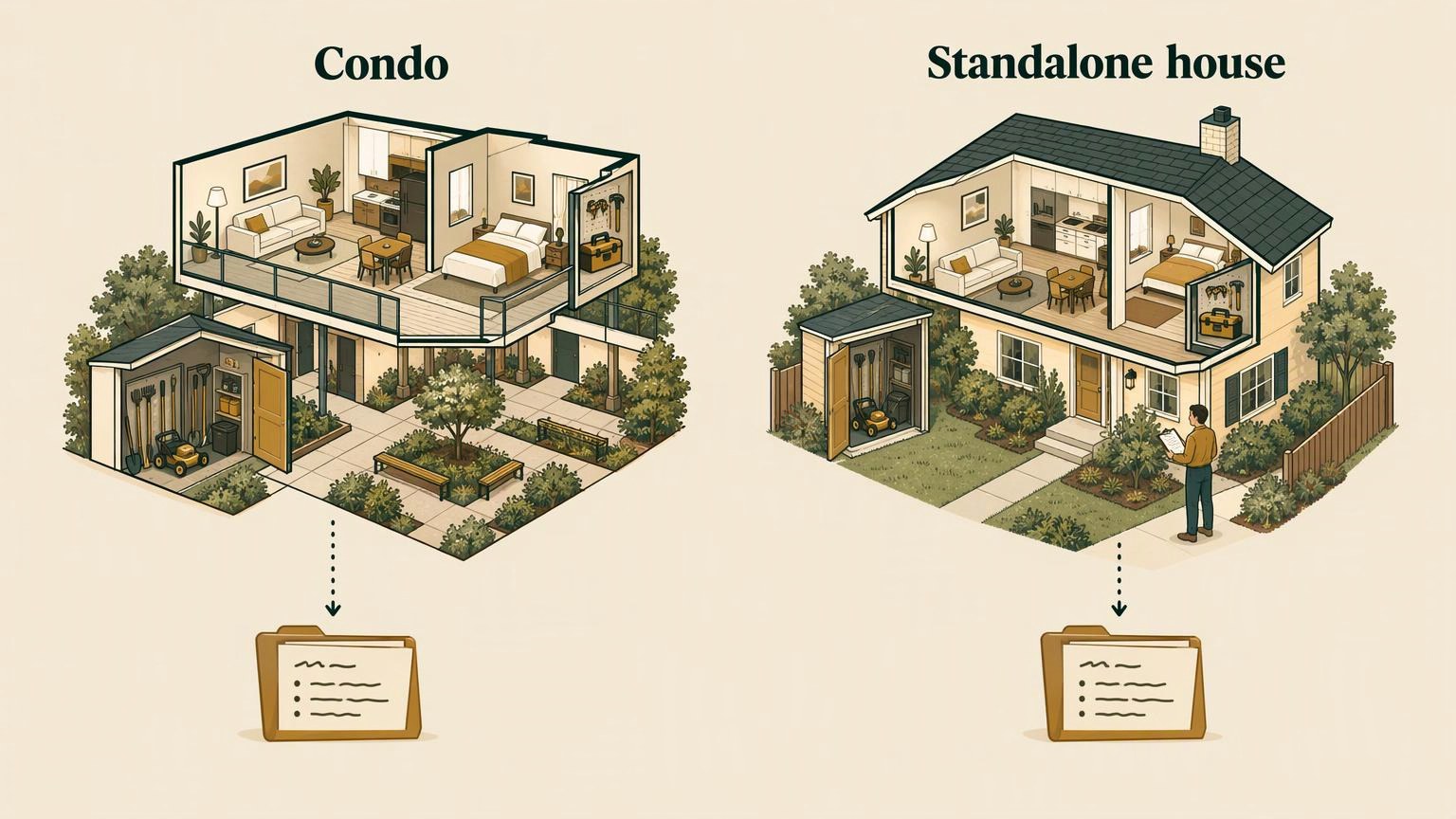
Illustration of condo and standalone house cutaways, each with tool storage and a folder below. An adult with a clipboard stands outside the house.
Account for currency exposure and eventual exit
Keep each expense in its stated currency before translating the budget into dollars. A dollar purchase price does not mean every recurring expense is dollar-denominated, and a converted total should identify the exchange-rate assumption used.
Exchange-rate changes can alter the dollar amount needed for a peso expense. A comparison can test a different exchange-rate assumption without presenting either result as a forecast.
Transaction-related conversion and transfer charges also belong in the appropriate part of the budget when applicable. Dated provider estimates establish those charges; a headline exchange rate alone does not describe the entire transfer cost.
Do not make resale the affordability plan
An eventual sale can involve expenses and uncertain timing. Qualified independent legal, tax, and financial professionals can explain the relevant obligations and help assess property-specific estimates.
Appreciation, resale proceeds, and returns are not guaranteed. A home that requires a favorable future sale to make current ownership manageable deserves a different evaluation from one whose operating costs already fit the intended budget.
Connect the budget to the life you want in Mexico
The Golden Life begins with everyday life and then connects those priorities to location and property. That approach gives the ownership budget a purpose: identifying a home whose costs and responsibilities fit retirement, relocation, a second home, or another defined objective.
The Next-Chapter Planner is a downloadable planning guide for organizing those priorities. It is a starting point for thinking through your next chapter, not a substitute for a property-specific cost estimate.
When you can describe your intended use, preferred responsibilities, and open property questions, you can start a Find your place inquiry with The Golden Life. Choose everyday life, properties and communities, or a question as your starting point.
Relevant property information should then be followed by a visit and independent due diligence before deciding. An inquiry or introduction does not replace verification by appropriately qualified professionals.