
Steps to buy a house in Mexico: a buyer's guide from offer to deed

The steps to buy a house in Mexico generally move from a written offer to a reviewed purchase agreement, documented deposit arrangements, property due diligence, ownership and funding preparation, closing, and final deed or registration follow-up. The sequence can overlap. A Mexican notary is involved in formal transaction documentation, while qualified independent professionals address the buyer's legal, tax, technical and financial questions.
Table of Contents
- 1. Put the offer and its conditions in writing
- 2. Understand the purchase agreement before the next commitment
- 3. Separate the deposit from the ownership transfer
- 4. Review the property, not only the sales description
- 5. Align ownership, funding and closing preparation
- 6. Understand the Mexican notary's role at closing
- 7. Follow the deed and documentation through completion
- How the sequence changes a buyer's decision
- Frequently Asked Questions
An accepted offer is the beginning of the purchase process, not evidence that every property question has been answered. The steps to buy a house in Mexico become easier to understand when you separate what the parties agree, what professionals verify, and what documents complete the transaction.
This guide starts at the offer stage and follows the purchase through final documentation. It is general educational information, not legal, tax, financing or investment advice. The applicable process depends on the property and circumstances; qualified independent professionals should explain the requirements and implications for a particular transaction.
1. Put the offer and its conditions in writing
A written offer gives the parties something specific to negotiate: the identified property, proposed price, intended payment arrangement and conditions under which the purchase would proceed. Agreement on price alone leaves other decisions open.
The first distinction is between a discussion and a document that creates obligations. A document called an offer, reservation or letter of intent should not be assumed to have the same effect as another document with a similar name. Its wording and the applicable law matter.
For general understanding, an offer discussion can cover:
- The property being purchased and anything intended to be included with it.
- The price, payment currency and proposed payment sequence.
- Which reviews remain to be completed before the transaction advances.
- The intended relationship between acceptance, deposit and a later agreement.
A qualified independent legal professional can explain what signing or accepting the particular document would mean. That explanation is especially relevant when an offer includes a payment deadline before the buyer has reviewed the property records.
The intended use also matters. The Golden Life's second-home and property investment overview provides context for distinguishing personal use from an investment objective, without establishing whether any particular property is suitable.
An offer sets out the proposed deal; destination and property fit address how that home would fit your life.
2. Understand the purchase agreement before the next commitment
The purchase agreement connects the negotiated deal to obligations: what each party is expected to deliver, when payments occur, and what happens if a condition is not met. The useful question is not simply whether a Mexico real estate contract looks complete, but whether its provisions work together.
For example, a review provision and a deposit provision address different issues. A document might allow a review without clearly explaining whether an unfavorable result changes the payment obligation. Qualified independent legal review addresses those relationships rather than considering each paragraph in isolation.
Terminology can vary across transactions. The following comparison explains the different jobs documents may perform; it does not establish the legal effect of any particular document.
| Document or stage | Main question | What it does not establish by itself |
|---|---|---|
| Written offer | What deal is being proposed? | That all property facts have been verified |
| Purchase agreement | What obligations and conditions have been agreed? | That every condition has been satisfied |
| Deposit instructions or receipt | Where does the money go, and how is payment recorded? | That the buyer has completed the ownership transfer |
| Final deed or applicable closing instrument | How is the transaction formally documented? | That every administrative follow-up or handover task is finished |
Pay attention to how the agreement handles change
Property descriptions, included items, completion conditions and payment arrangements should be understandable as a connected deal. The same is true of the provisions addressing delay, cancellation, notices and disputes.
An agreement can appear workable when everything goes as expected and become difficult to interpret when a document is missing or a payment cannot be made on the proposed date. A legal professional can explain the available protections and obligations without assuming that an informal assurance changes the written agreement.
| Document | Main question | Does not prove |
|---|---|---|
| Written offer | What deal is proposed? | All property facts are verified |
| Purchase agreement | What obligations and conditions apply? | Every condition has been satisfied |
| Deposit instructions or receipt | Where does money go; how is it recorded? | Ownership transfer is complete |
| Final deed or closing instrument | How is the deal formally documented? | All follow-up and handover tasks are done |
Understanding purchase obligations is separate from deciding whether a destination and property suit your priorities.
3. Separate the deposit from the ownership transfer
A deposit is a money-handling milestone. It should not be treated as proof that the property is legally ready to transfer, that all conditions have been met, or that the buyer can recover the funds in every circumstance.
There is no deposit amount or percentage established here. The amount, recipient, holding arrangement, payment timing and release terms depend on the particular transaction and documentation.
Understanding a deposit to buy property in Mexico involves several separate questions: who receives it, in what capacity, under which agreement, and what event permits its release. A payment receipt answers a different question from a cancellation or refund provision.
Descriptions such as refundable or held securely are incomplete without the terms behind them. Relevant details include who decides whether a condition has been satisfied, what documentation is required, and what happens if the parties disagree.
Qualified independent legal and financial professionals can explain the proposed arrangement and verification methods for payment instructions. This is also where currency and transfer questions intersect with the contract: the parties need a shared understanding of how the payment is measured and recorded.
The practical trade-off is that an early payment may move the commercial discussion forward while some verification remains incomplete. That makes the terms attached to the payment more important, not less.
4. Review the property, not only the sales description
Due diligence separates information used to market a property from information needed to understand the transaction. A photograph can show a room; it cannot establish the seller's authority, the property's legal status or the condition of a concealed building system.
The review has different tracks. Legal professionals examine the relevant ownership and transaction questions, while appropriately qualified technical professionals assess physical matters within their scope. Neither review is a substitute for the other.
Legal and documentary questions
Topics for independent professional review include how the property is identified, who has authority to sell, what records support the proposed transfer, and whether interests or obligations affect the transaction. The professional determines which documents and searches are appropriate.
Documents should also be read against the intended use. A buyer who expects personal occupancy and a buyer who expects rental use may have different questions, even when they are considering the same house. No rental permission, income or return should be assumed from marketing language.
Physical condition and everyday use
A technical review addresses the building rather than the strength of the sales presentation. Its scope might include the systems, structure or defects that the relevant professional is qualified to evaluate.
The buyer's own visit serves another purpose: understanding whether the property fits everyday life. That experience is useful, but it does not replace technical investigation or legal review. Mexperience's educational overview likewise treats property essentials, financing and buying procedures as distinct subjects.
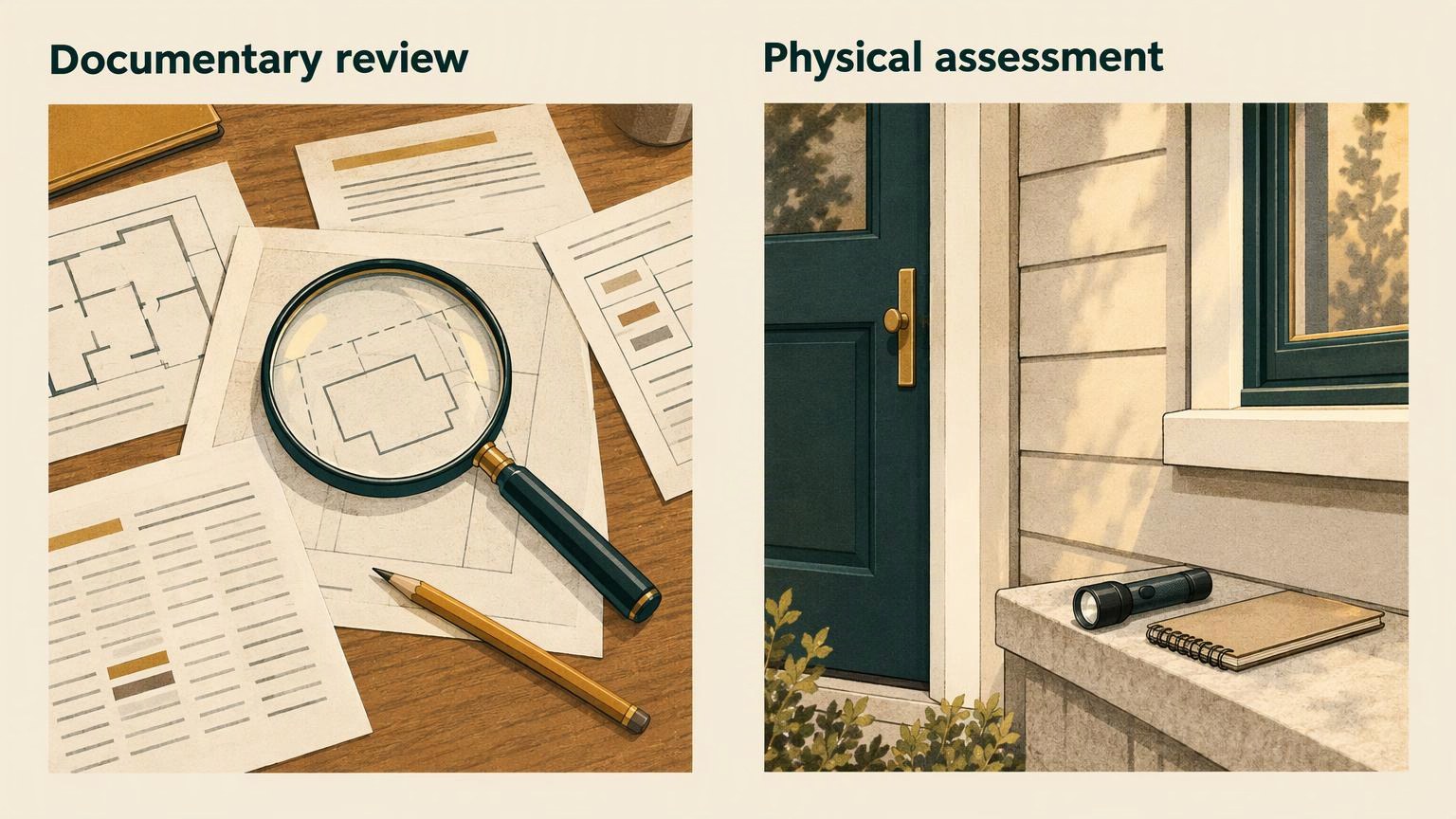
Illustration pairing a research desk under 'Documentary review' with a doorway, window, flashlight and notebook under 'Physical assessment'.
5. Align ownership, funding and closing preparation
Foreigners can buy property in Mexico. The ownership structure depends on location and circumstances, including special structures in restricted coastal and border zones. Qualified independent legal and tax professionals are needed for any transaction.
If a fideicomiso is raised in the transaction, it belongs in the ownership discussion before final documents are prepared. The relevant professionals can explain which structure applies, the documents involved, and any continuing obligations. A general buyer guide cannot determine that structure for a particular property.
Funding preparation runs alongside these questions. Financing may be available for qualified U.S. buyers through licensed providers. Eligibility, property requirements, underwriting, rates, terms, fees and approval apply.
The Golden Life's financing overview for U.S. buyers introduces that conversation. It does not establish approval, a rate or terms for a specific buyer or property.
Closing costs also belong in preparation, not as a surprise after the purchase price has been agreed. A transaction-specific breakdown can distinguish the purchase payment from professional charges, documentation costs, applicable taxes and any ownership-structure charges, with qualified professionals explaining what applies.
The useful comparison is between the full proposed funding requirement and the funds actually available under confirmed arrangements. A general estimate cannot establish that a particular closing is fully funded.
6. Understand the Mexican notary's role at closing
A Mexican notary is involved in the formal documentation of a real estate transaction. For an American buyer, the important distinction is that this role should not be understood merely as witnessing a signature in the familiar U.S. sense.
The exact scope and requirements need an explanation for the relevant jurisdiction and transaction. The notary's office can clarify the documents it requires, the formal instrument being prepared, the signing arrangements and the follow-up connected to that instrument.
Notary coordination and independent representation answer different questions. Formal transaction work does not remove the need for an independent legal professional to explain the buyer's contractual position or for a technical professional to evaluate the building.
At closing, several matters converge: the final document, the payment arrangements, the status of agreed conditions and the intended handover. These should not be assumed to happen at the same moment simply because everyone refers to a closing date.
A useful closing explanation identifies the document being signed, who signs it, what each payment corresponds to, and which matters continue afterward. Changes between the agreed transaction and the final instrument are questions for the relevant qualified professional, rather than details to infer from an earlier draft.
No standard completion timeline is promised here. Missing documents, ownership questions, funding requirements and administrative work can affect the sequence.
7. Follow the deed and documentation through completion
Collecting keys and receiving final ownership documentation are different events. Handover concerns access and possession; the deed or applicable instrument concerns formal documentation. Registration and other administrative follow-up need their own explanation.
The notary's office and independent legal professional can identify what final records apply, how they will be delivered, and how the status of required follow-up is established. A signed copy, an acknowledgment and a completed record should not be assumed to mean the same thing.
The handover discussion covers practical matters such as included items, access arrangements and the property's condition at delivery. Those questions should be distinguished from legal completion, even when the parties coordinate them together.
Closing records also matter after the purchase. A coherent transaction file connects the signed agreement, payment records, final instrument and relevant supporting documents. Qualified legal and tax professionals can explain the retention and future-use requirements that apply.
The end point is therefore clearer than simply being told that the deal is done: the relevant professionals have explained which transaction milestones are complete, which records establish them, and whether anything remains in progress.
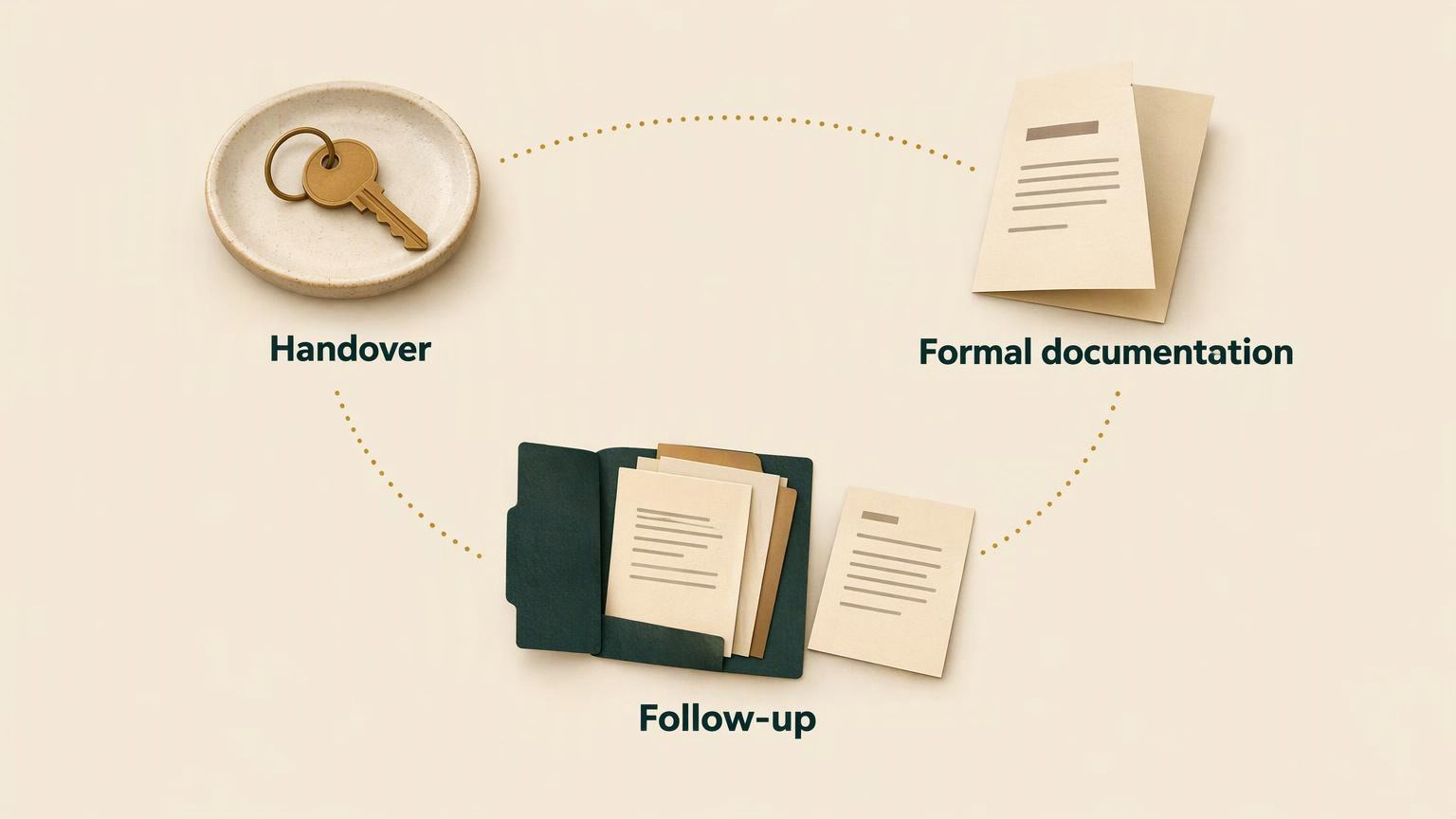
Illustration showing three distinct labeled areas—Handover, Formal documentation and Follow-up—with a key, document and paper-filled folder connected by dotted curves without arrows.
How the sequence changes a buyer's decision
Say you are considering an existing house for part-time personal use. One possible purchase has accessible property records and permits professional review before the next payment; another asks for an early commitment while important records remain unavailable.
The house you prefer visually may be the second one. That preference does not answer the transaction question: what would the early commitment mean while the review is incomplete?
The meaningful comparison is the relationship between available evidence and the next obligation. In the first purchase, the buyer can evaluate more of the transaction before advancing; in the second, independent legal review must explain the exposure created by committing before those questions are answered.
If incomplete verification exceeds what the buyer is prepared to accept, the first purchase is the more consistent process choice. That does not establish that its title or physical condition is satisfactory, nor does it prove that the second purchase is defective.
Before evaluating either purchase, intended use and destination fit still deserve attention. The Golden Life connects those priorities to property direction through the Find your place: share your priorities and send an inquiry to The Golden Life. The report does not establish transaction readiness or property availability.