
Should you rent or buy in Mexico?

Renting first is often the more useful starting point if you have not experienced everyday life in your intended Mexican destination. Buying becomes worth exploring when the location fits, your intended use is clear, and you understand the full costs and responsibilities. Neither option is universally better: renting preserves flexibility, while ownership creates an ongoing commitment that requires independent due diligence.
Table of Contents
- Which living arrangement fits your purpose?
- What should renting before buying help you learn?
- How do you compare the full financial picture?
- What responsibilities come with each choice?
- What kind of property or use rights are you considering?
- How does the choice change as you learn more?
- How can The Golden Life help you take the next step?
- Frequently Asked Questions
The decision to rent or buy in Mexico starts with how you will use the home. Retirement, relocation, and occasional visits place different demands on a property, even when the setting appeals equally to you.
A vacation can reveal what you enjoy without showing what daily life requires. Renting before buying lets you explore that difference without making a property purchase your first experiment. The useful comparison is between a living arrangement that fits your life now and an ownership commitment you understand, rather than between renting as a failure and buying as an achievement.
Which living arrangement fits your purpose?
Start by separating learning about a destination from committing to a home there. A trial rental answers questions about place and routine. Continued renting can support an established life without ownership. Buying introduces a property commitment alongside the lifestyle choice.
Mexico is not a single housing market. Alto Nivel's April 21, 2017 analysis illustrated how local housing prices and access to financing affected the rent-versus-buy choice. That historical context supports comparing a specific location, not using old figures as today's budget.
Your intended use matters just as much. A retirement home must work for ordinary daily routines. A second home must also make sense while you are elsewhere. A rental-income objective needs separate evidence beyond your own enjoyment of the property.
| Arrangement | Best question it answers | Main trade-off | Useful evidence |
|---|---|---|---|
| Trial rental | Would everyday life here suit me? | Temporary housing may differ from the home you eventually want | Observed routines, practical errands, and seasonal conditions |
| Continued renting | Can I live here without taking on ownership? | Control and continuity depend on the rental agreement | Current terms, renewal provisions, and total living costs |
| Exploring a purchase | Does a specific property fit a settled purpose? | Capital commitment and ongoing ownership responsibilities | Current documents, property condition, full costs, and independent review |
| Arrangement | Best use | Main trade-off |
|---|---|---|
| Trial rental | Test everyday life in a destination | May differ from your eventual home |
| Continued renting | Live here without taking on ownership | Control and renewal depend on terms |
| Exploring a purchase | Find a property for a settled purpose | Capital commitment and ongoing duties |
What should renting before buying help you learn?
A useful trial stay tests the life you expect to lead, not only the activities you would choose on vacation. Cook at home, buy groceries, spend time without a planned outing, and repeat the routes you expect to use. Notice whether the setting still suits you after the initial novelty fades.
The rental itself is only part of the experiment. A serviced vacation apartment may make daily life easier than an unfurnished home would. Separate the convenience supplied by the accommodation from the qualities of the destination.
Compare places through the same routines
Riviera Maya combines Caribbean coastline, growing residential communities, and international access. That makes the relationship between a residential setting and your regular errands worth testing rather than assuming a coastal address answers both needs.
Puerto Vallarta has a mountain-framed bay, an established international community, neighborhood character, and everyday city services. A trial stay can help distinguish the appeal of the bay from the particular neighborhood rhythm you want.
Use the same questions in either destination: where would you spend an ordinary afternoon, how would you meet people, and what does leaving home for a routine errand involve? The Living Well in Mexico lifestyle guide provides a broader starting point for comparing places through everyday life.
Keep observations separate from expectations
Record what you actually experienced and what you have only heard or imagined. A quiet visit does not establish year-round noise conditions, and an enjoyable season does not show how you will feel in different weather.
There is no universal trial-stay length that makes someone ready to buy. The useful milestone is whether you have tested the routines and conditions that could change your decision. A return visit may answer a specific question better than simply extending the same experience.

Illustration of everyday routines: unpacking groceries and making notebook marks in a kitchen overlooking a shaded neighborhood street, with walking shoes nearby.
How do you compare the full financial picture?
Rent and a mortgage payment are not equivalent measures of housing cost. One describes a rental charge; the other may cover only part of an ownership commitment.
Alto Nivel's May 28, 2018 comparison explained why acquisition costs, financing costs, and the use of capital belong in the calculation. Its historical examples are not current Mexican property quotes or a forecast for your circumstances.
Build a rental total
Use the actual agreement to distinguish rent from deposits, utilities, furnishings, and any other charges. A refundable deposit is different from an expense, but it still affects the cash needed to move in.
Also account for what changes if you leave or renew. A rental that looks inexpensive on its advertised monthly charge may fit poorly if its term does not match your intended stay.
Build an ownership total
A purchase comparison includes acquisition expenses and recurring obligations, not just the advertised price. Depending on the property and structure, relevant categories can include transaction expenses, financing, maintenance, shared-community charges, and other ownership costs.
For a second home, the comparison also needs to address care while you are absent. Use current property documents and itemized estimates; qualified independent legal, tax, and financial professionals can assess which obligations apply.
Keep lifestyle value separate from financial assumptions
Having a home arranged around your preferences has personal value. That does not establish appreciation, rental income, or a financial return.
Renting preserves capital that would otherwise be committed to a purchase, but alternative uses of that capital have their own risks. A meaningful financial comparison uses consistent assumptions and professional analysis rather than treating either property growth or investment returns as certain.
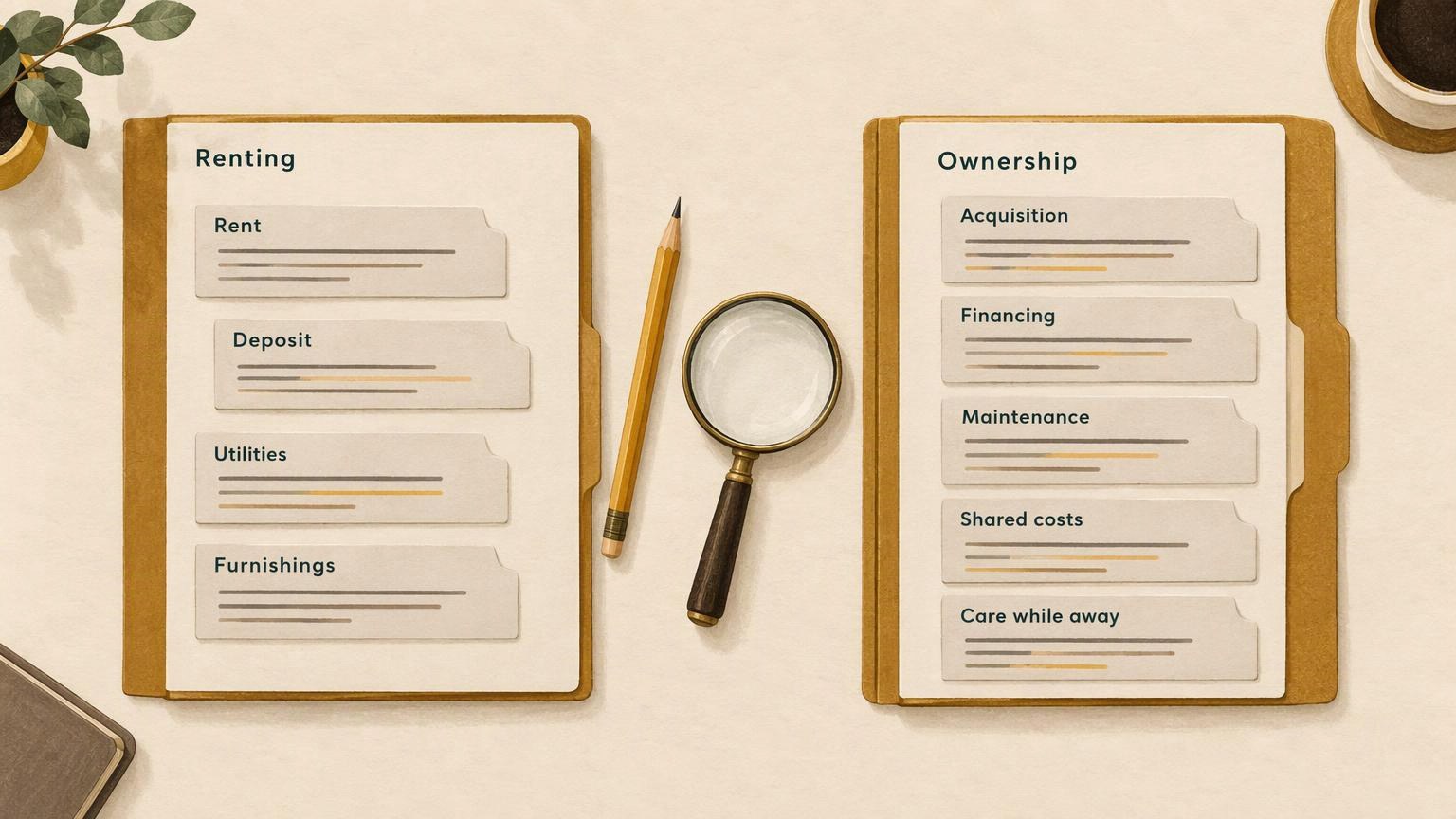
Illustration of side-by-side Renting and Ownership folders with labeled comparison categories, separated by a pencil and magnifying glass.
What responsibilities come with each choice?
Flexibility does not mean a rental has no obligations, and ownership does not mean unlimited control. The agreement and property documents determine the practical limits.
Renting depends on the actual agreement
A rental agreement should make the term, payment obligations, included items, repair responsibilities, and departure conditions understandable. Do not assume that rules familiar from a U.S. rental apply to a Mexican agreement.
Record the property's condition and any promised work before moving in. If the agreement is in a language you do not fully understand, translation can help with comprehension, while qualified independent legal review addresses its meaning and obligations.
Longer-term renting has an honest downside: your ability to remain, renew, or change the home depends on the terms you have agreed to. That can be acceptable when mobility matters more than customization.
Buying creates an ongoing commitment
Ownership introduces responsibility beyond choosing the home. The building's condition, shared arrangements, ongoing expenses, and permitted uses matter after the purchase as much as before it.
For Americans, the ownership structure depends on location and circumstances, including special structures in restricted coastal and border zones. Qualified independent legal and tax professionals should review any transaction.
A successful stay in the area cannot verify the seller's rights, technical condition, or the obligations attached to a particular property. Lifestyle confidence and transaction readiness are separate conclusions.
What kind of property or use rights are you considering?
Before comparing renting with buying, identify what the proposed purchase actually includes. Full ownership, fractional interests, timeshares, and land are different products, not interchangeable ways of describing a home.
The following distinctions are general educational categories. The specific rights, charges, permitted uses, and exit provisions require review of the actual documents by qualified independent professionals.
| Product | Rights and use | Fees and responsibilities | Exit questions |
|---|---|---|---|
| Full ownership | Ownership of a property through the applicable structure; use remains subject to relevant restrictions | Property obligations and any shared-community costs | Transfer requirements, selling expenses, and market uncertainty |
| Fractional interest | A defined interest with use or access governed by the documents | Shared costs and management obligations under the arrangement | Transfer limits, approval requirements, and resale conditions |
| Timeshare | Defined accommodation-use rights under the contract; not equivalent to whole-property ownership | Contractual charges, use conditions, and possible ongoing fees | Cancellation, transfer, and termination provisions |
| Land | Rights to a parcel; not a completed home or proof of buildability | Holding obligations and any future development expenses | Transfer conditions and the effect of permitted use |
Match the product to the reason you want it
If your goal is an everyday home, an arrangement with limited use periods may not solve the same problem. If your goal is occasional accommodation, whole-property ownership may involve responsibilities you do not want.
A trial rental helps clarify the amount and kind of access you value. It does not establish the suitability of a purchase contract. None of these products guarantees resale, rental income, appreciation, or returns.
How does the choice change as you learn more?
Say you are considering retirement in Mexico but do not yet know whether you want to live there throughout the year or divide your time with the United States. You enjoy coastal settings and want regular social contact, but your experience so far has been vacations.
A trial rental answers the most immediate question: whether ordinary life matches the attraction. Buying now would combine an untested lifestyle choice with a property commitment. Continued renting remains an option even if the trial goes well.
During the stay, you discover that you enjoy the community but still want freedom to spend extended periods elsewhere. Renting may fit that preference better because you are choosing flexibility deliberately, not because the trial failed.
Now change the facts. You have returned under different conditions, your intended use has become clear, and you want a stable home arranged around your routines. Exploring a purchase becomes more relevant, provided a specific property's costs, rights, condition, and obligations receive independent review.
The difference is not simply the number of visits or whether you can afford the advertised price. It is whether ownership solves a settled need. If the purchase only seems workable with projected rental income, the financial case still needs separate analysis.
How can The Golden Life help you take the next step?
The Golden Life begins with your intended life in Mexico, then connects that purpose to destination and property questions. Its process moves from defining an objective to reviewing relevant information, visiting communities, and completing independent due diligence before deciding.
For a rent-first approach, the immediate task is to identify what a visit should teach you. The downloadable Next-Chapter Planner is a planning guide for organizing that next chapter, not a substitute for transaction review.
You can start a Find your place inquiry with everyday-life priorities, property and community interests, or a question. The inquiry opens a separate form; it is not a rental reservation or a promise of property availability.
This article is general educational information, not professional advice. Independently verify material facts and use appropriately qualified professionals for personal legal, tax, immigration, financial, medical, insurance, technical, or investment matters.