
Selling property in Mexico as a foreigner: planning for sale or inheritance
Selling property in Mexico as a foreigner and passing it to heirs are different planning questions. A sale centers on ownership, transfer, costs, and proceeds; inheritance centers on succession documents and who can act. The applicable path depends on the property and your circumstances. Qualified independent Mexican legal professionals, a notary, and cross-border tax advisers can explain the requirements and consequences for a particular case.
Table of Contents
- Which exit are you planning for?
- What exactly would be sold or inherited?
- How does a lifetime sale differ from finding a buyer?
- Why is the sale price different from usable proceeds?
- What happens to your Mexico property when you die?
- Would keeping the home actually suit your family?
- How The Golden Life fits the second-home decision
- Frequently Asked Questions
A second home may fit your life today but become difficult for your family to manage later. Selling property in Mexico as a foreigner belongs in the original purchase decision, alongside everyday use and ongoing costs.
The useful question is broader than whether someone might buy it: what would a sale involve, and what would happen if family members inherited instead? For Americans, those questions can span Mexico and the United States. This article is general educational information, not professional advice; individual legal and tax conclusions belong with qualified independent professionals.
Which exit are you planning for?
A lifetime sale lets the owner participate in the decision. An inheritance adds a different question: who has the documented authority to make decisions about the property after the owner's death?
That distinction matters even when the family's eventual goal is the same. Wanting to sell an inherited home does not, by itself, establish who can sign or how a transfer will proceed. Those are matters for the legal review.
The comparison below separates the family decision from the professional questions. None of these paths promises a buyer, a completion date, or a particular legal result.
| Possible path | Family objective | Professional question | Practical trade-off |
|---|---|---|---|
| Owner sells during life | End ownership while the owner can participate | What ownership, transfer, and tax requirements apply? | The owner gives up future use and still faces an uncertain selling period. |
| Family inherits and keeps the home | Continue family use | Who succeeds to the relevant rights, and through what process? | Family members need an ongoing plan for use, expenses, and management. |
| Family inherits and later sells | Convert the property into proceeds | Who can authorize the sale, and what reviews precede it? | The family faces both inheritance questions and sale questions. |
| Exit path | Family goal | Legal review | Trade-off |
|---|---|---|---|
| Owner sells during life | End ownership with owner participating | Ownership, transfer and tax requirements | Give up future use; sale timing uncertain |
| Family inherits and keeps | Continue family use | Who succeeds to rights, and how? | Ongoing use, expenses and management |
| Family inherits, then sells | Convert property into proceeds | Who can authorize a sale? | Both inheritance and sale questions |
What exactly would be sold or inherited?
Foreigners can own property in Mexico. The ownership structure depends on location and circumstances, including special structures in restricted coastal and border zones.
For exit planning, the important starting point is the actual documentation, rather than the phrase "own a home." A property description tells you what the place looks like; the relevant agreements and ownership records explain the interest being reviewed.
The broader guide to whether Americans can buy property in Mexico provides the purchase context. Here, the focus is what that ownership means for a later change.
Ownership format changes the question
Full ownership, fractional ownership, timeshare, and land are different products. Their rights, use arrangements, fees, and exit terms should not be treated as interchangeable.
A listing's use of "property" does not answer whether the transaction concerns a whole home, a shared interest, or a contractual use arrangement. A qualified independent legal professional can explain the specific documents and what they permit.
Trust paperwork belongs in the same review
If the documents identify a bank trust, or fideicomiso, its paperwork belongs alongside the other property and estate documents. A family reference to "the house" may leave out the legal structure through which it is held.
The practical distinction is between knowing that a document exists and knowing how it applies. The latter requires professional interpretation, including any questions about beneficiary designations, changes, or a future transfer.
How does a lifetime sale differ from finding a buyer?
A buyer's interest is a market question. Whether the proposed transaction can proceed on the stated terms is a separate legal and financial question. An appealing home can still have documentation questions that need resolution before a transfer.
At a general level, sale planning brings together the property records, the proposed agreement, professional review, and the financial explanation of the transaction. A Mexican notary and appropriately qualified independent professionals can explain which requirements apply.
Ownership history, property-tax records, and prior transaction documents are examples of material that may come into that review. The professional handling the matter determines what is needed; a generic document list is not a complete set of requirements.
This distinction also affects expectations about timing. A marketing estimate concerns attracting a buyer, while a transaction estimate concerns completing the proposed transfer. One does not establish the other.
For a second-home owner, the downside is practical: a planned sale may not coincide with the date the family wants to stop using or managing the home. A quoted completion period is therefore different from a guarantee that ownership will end by that date.
Why is the sale price different from usable proceeds?
The sale price is the amount agreed for the transaction. Usable proceeds are the amount ultimately available after the applicable financial items have been accounted for. Treating them as the same number can distort an exit plan.
A transaction-specific explanation separates the sale price from relevant taxes, transaction charges, and any obligations connected with the property. It also identifies what remains an estimate and who is responsible for confirming each item.
Capital gains tax on Mexican property is not a question that can be answered reliably with a single percentage in this article. A qualified Mexican tax adviser and the notary can explain the current treatment, calculation, documentation, and any payment or withholding process applicable to a particular sale.
Mexican and U.S. questions are separate
For an American owner, a Mexican transaction review does not replace a review of possible U.S. tax and reporting questions. Qualified cross-border tax professionals can explain how the circumstances are treated in each country.
This is especially important when the family's question is "How much would be available afterward?" A Mexican closing calculation and a complete cross-border financial picture are different things.
Records support analysis, not automatic deductions
Purchase documents, expense records, and records of work on the property can help a professional understand its history. Their existence does not establish a particular deduction or tax outcome.
The useful distinction is between a cost you remember paying and a cost whose treatment a qualified tax professional has evaluated. No exemption, deduction, or tax-saving result is assumed here.
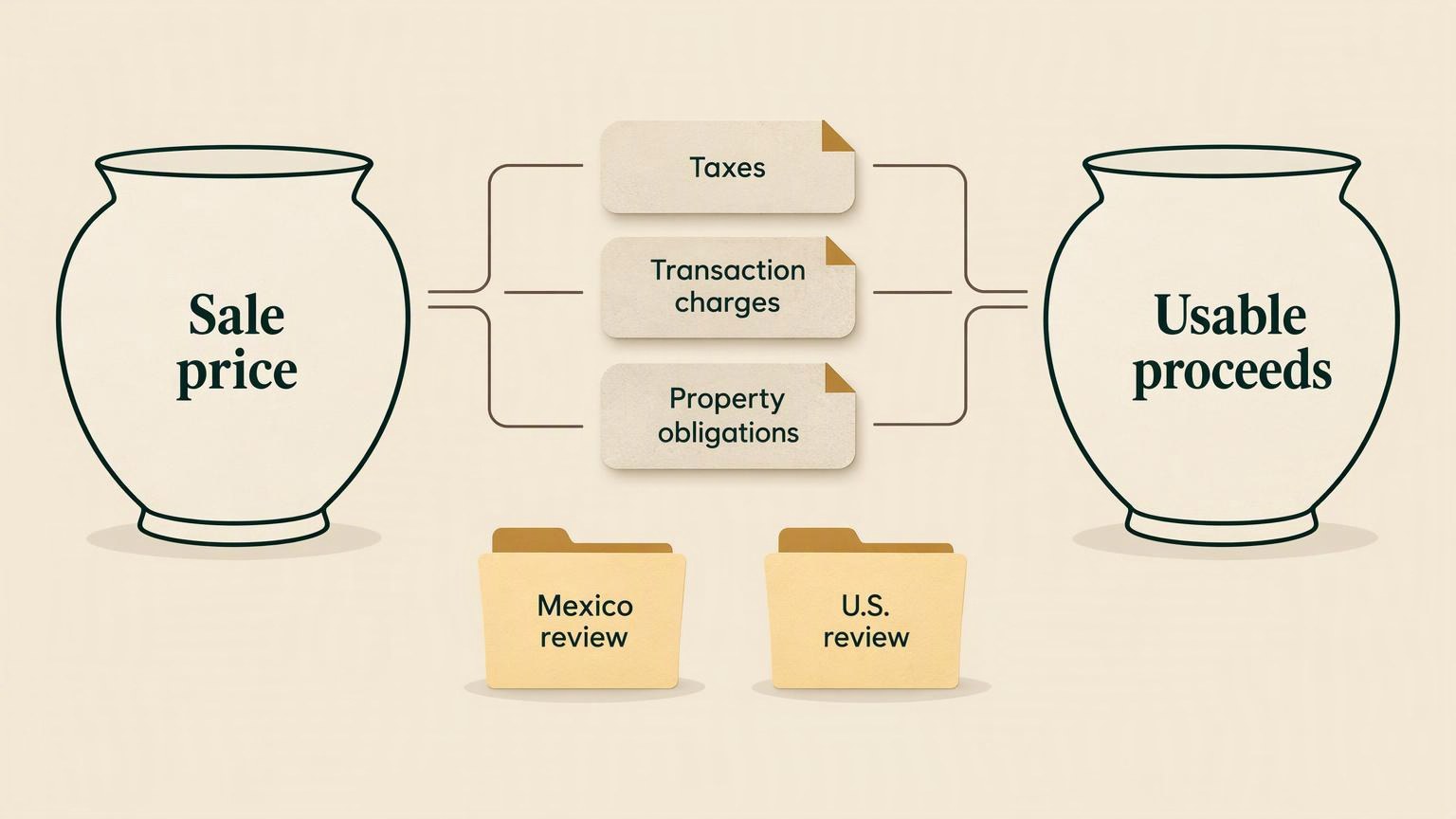
Illustration linking Sale price and Usable proceeds through tabs labeled Taxes, Transaction charges, and Property obligations, above separate Mexico review and U.S. review folders.
What happens to your Mexico property when you die?
The answer depends on the ownership structure, relevant estate and property documents, and the applicable legal process. This article cannot identify an heir or establish that a named person can immediately manage, use, or sell the property.
Inheritance of property in Mexico by a foreigner therefore calls for its own review, rather than simply reusing the owner's purchase plan. The family needs an explanation of who may act and what steps apply before decisions about keeping or selling the home.
A family understanding and documented legal authority are different things. Everyone may agree that a child should keep the home, yet that agreement alone does not answer how the relevant rights would pass.
A Mexican will is a coordination question
For foreigners considering a Mexican will, the useful professional question is how estate documents in Mexico and the United States relate to one another. A qualified independent estate lawyer or notary can explain the available approach for the person's circumstances.
A U.S. will should not be assumed to settle every Mexican property question, and this article does not prescribe a Mexican will as the answer in every case. Recognition, document formalities, and the interaction between instruments require professional advice.
A beneficiary name is not a complete process explanation
If property or trust documents contain beneficiary designations, those designations belong in the estate review. Their presence is not, by itself, an explanation of every step a family may face after a death.
The review can distinguish the intended recipient from the person authorized to act, then explain how the documents work together. No automatic transfer or avoidance of an estate procedure is promised.
Inheritance does not answer whether the family wants the home
Legal succession and family preference are separate decisions. An heir may value the owner's connection to Mexico without wanting responsibility for a second home.
Keeping the property raises everyday questions about use and management. Selling it raises transaction questions. A family plan is more useful when it acknowledges both possibilities rather than assuming everyone wants to continue the owner's lifestyle.
Would keeping the home actually suit your family?
Say you are considering a Mexican second home for retirement and seasonal stays. Your adult children enjoy visiting, but neither wants responsibility for organizing repairs or managing a home abroad.
Keeping the property for family use preserves a place they enjoy. It also asks them to accept work they have already said they do not want. Enjoying visits is different from agreeing to ownership responsibilities.
A sale during your lifetime would let you participate in the decision and clarify your own next step. The trade-off is giving up future use, while the sale price and completion remain uncertain.
Inheritance followed by a sale preserves your use while you are alive, but leaves the family to address both succession and a later transaction. It does not remove the exit questions; it changes who will face them.
For this family, a plan centered on eventual sale fits the stated preferences better than an assumption of permanent family ownership. That is a lifestyle conclusion, not a recommendation about estate instruments or tax treatment; qualified professionals determine how any chosen approach can be implemented.
The same reasoning belongs in the purchase decision. A home that suits one person's daily life may still be a poor match for the responsibilities that person hopes to pass on.

Illustration of an older adult gesturing between vacation pictures and a sun hat on one side of a table and a folder, wrench and keys on the other, while two younger adults listen.
How The Golden Life fits the second-home decision
The Golden Life begins with the life you want to live, then connects those priorities with location and property evaluation. For a second-home search, that includes whether the intended use is personal, shared with family, or expected to change later.
Exit planning adds substance to that conversation. "A home my children can enjoy visiting" is a different objective from "a home my children want to own." Making that distinction early helps define what the property decision is meant to accomplish.
The downloadable Next-Chapter Planner is a planning resource. It does not replace a property-specific legal, estate, or tax review.
You can share your second-home priorities through Find your place, choosing everyday life, properties and communities, or a question as the starting point. The inquiry opens a separate form; it is not an estate instruction or a transaction authorization.