
Safest places to live in Mexico: what to check before choosing
There is no universally safest place to live in Mexico. A useful comparison starts with the current U.S. State Department advisory for each destination's state and its issue date, then examines the specific neighborhood, travel routes, and daily routines involved. A travel advisory is one part of relocation research, not a neighborhood ranking or a guarantee of personal safety.
Table of Contents
- How should you read Mexico's travel advisory by state?
- Which evidence answers which question?
- How does destination appeal connect to ordinary life?
- What should you evaluate beyond the neighborhood name?
- Which questions need their own professional review?
- How would the comparison work for a real-life decision?
- Turn your findings into a destination brief
- Frequently Asked Questions
Searching for the safest places to live in Mexico usually means asking something more personal: could you build an ordinary life there with risks you understand? That question deserves more than a list of cities or reassuring vacation stories.
Retirement, seasonal living, and a permanent move create different routines. The Golden Life's retirement and relocation framework starts with those routines, including access, community, climate, and mobility. Safety research belongs alongside them, with a clear distinction between official guidance, firsthand observations, and questions for qualified independent professionals.
How should you read Mexico's travel advisory by state?
Begin with the U.S. State Department's official Mexico travel advisory. Record the issue or update date shown on that advisory, then locate the entry for the state containing your destination. The date on a travel article, search result, or social post is not a substitute for the official advisory date.
Your research record should preserve the state's wording rather than reduce it to a color or category. Read any geographic qualifications and any separate restrictions described for U.S. government employees. Keep those restrictions distinct from the guidance addressed to travelers.
A destination name and a state name are not interchangeable. Los Cabos is in Baja California Sur; Baja California is a separate state. Looking up only the word "Baja" is not precise enough for an advisory comparison.
Keep the issue date and your review date separate
The issue date tells you which official advisory you read. Your review date records when you checked it. Save both with the official page address and the relevant state entry so someone reviewing your notes can tell exactly what informed the comparison.
Repeat that review when your plans change or before relying on the information for a visit. A saved screenshot is useful documentation, but it should not become a permanent substitute for checking the official page.
Read for the decision you are making
For a relocation search, write down what the advisory means for the locations and routes under consideration, without extending its wording into a personal safety prediction. Questions about interpreting security conditions can be taken to a qualified independent security professional.
Do not infer that a destination is suitable for full-time living simply because an advisory does not address a particular residential concern. That concern still belongs in your local evaluation.
Which evidence answers which question?
Official advisories, local accounts, and property documents have different jobs. The mistake is letting one type of evidence answer a question it was never designed to answer, such as treating a resident's pleasant experience as proof about future conditions.
Use the comparison below to organize information, not to score cities. A missing answer remains a question; it should not quietly become a favorable assumption.
| Evidence | Useful question | Limit |
|---|---|---|
| Dated official state advisory | What guidance applies to this state's travel context? | Does not establish a household's neighborhood fit |
| Specific resident account | What does this person's daily routine involve? | One experience cannot establish conditions for everyone |
| Your observations during a visit | Does this street or route support the routine you want? | A visit covers only the conditions you experience |
| Property documents reviewed independently | What building-specific facts can be established? | Building information does not replace regional safety research |
Make local accounts concrete
Ask about an actual routine: where someone shops, how they travel, whether they drive, and what changes after dark. Note when the conversation took place and whether the person lives there year-round or visits seasonally.
An account becomes more useful when you understand its limits. Someone whose outings happen mainly inside a managed property may have little experience with the routes your household expects to use.
| Evidence | Use it to check | Limit |
|---|---|---|
| Dated official state advisory | State travel guidance | Does not establish neighborhood fit |
| Specific resident account | That person's daily routine | One experience cannot apply to everyone |
| Your visit observations | Street and route fit for your routine | Only covers conditions you experience |
| Independently reviewed property documents | Building-specific facts | Does not replace regional safety research |
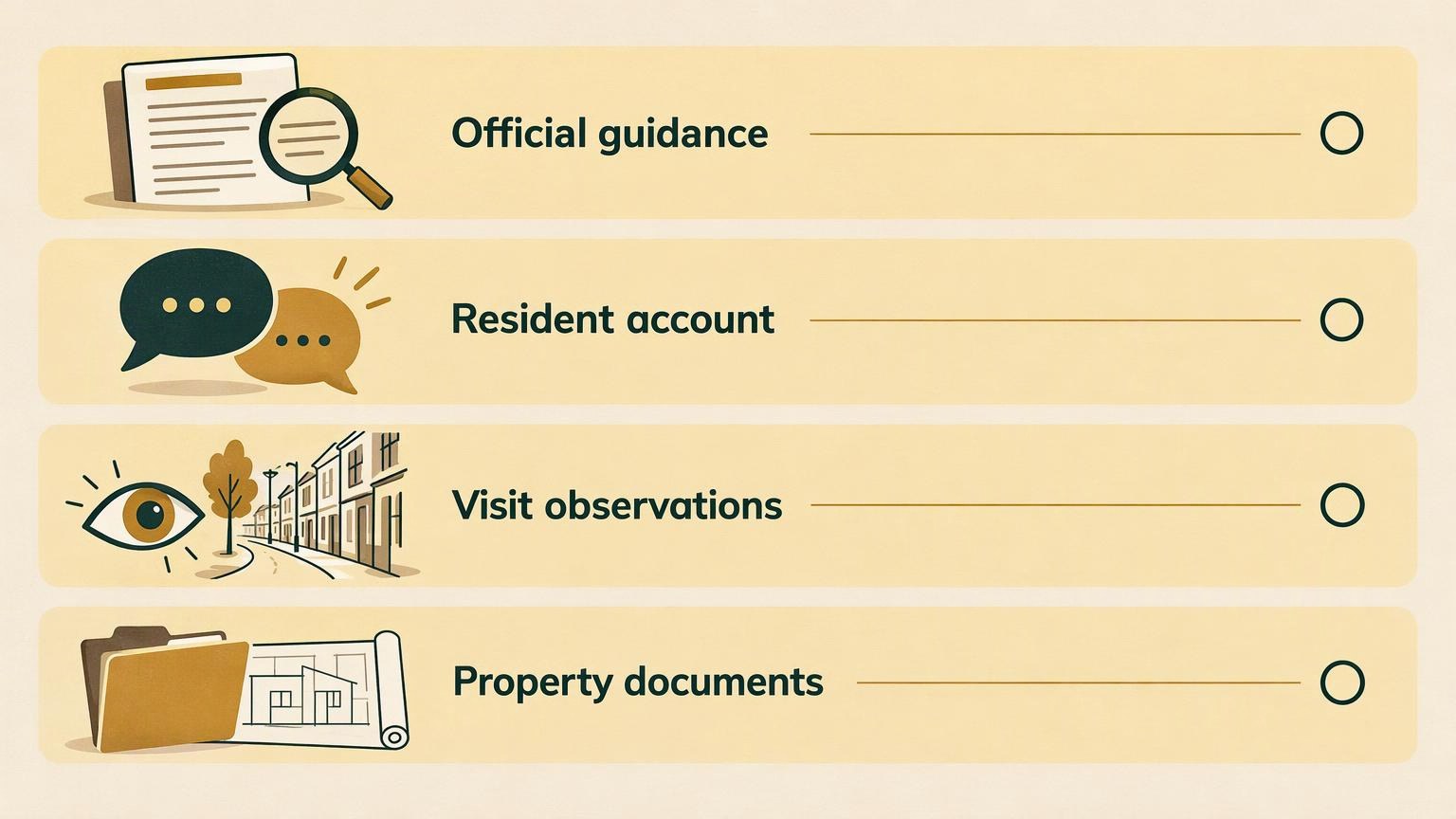
Illustration with separate lanes labeled Official guidance, Resident account, Visit observations, and Property documents, each paired with an icon and an open circle rather than a rating.
How does destination appeal connect to ordinary life?
Compare places through the life they suggest, while keeping their safety assessment separate. Los Cabos combines a desert landscape and the Sea of Cortez with marina life, golf, polished amenities, and strong links to the United States. Those details help frame lifestyle questions, but they are not evidence of a particular neighborhood's safety.
Baja California has Pacific coastline, wine country, and cooler coastal pockets. That makes climate and the kind of community you want relevant to its evaluation; it does not make its advisory interchangeable with Baja California Sur's.
Puerto Vallarta brings a mountain-framed bay, an established international community, neighborhood character, and everyday city services. Its appeal invites a neighborhood-level comparison: does the part you are considering support your actual shopping, social, and transportation habits?
The Riviera Maya combines Caribbean coastline, growing residential communities, and international access. A useful comparison distinguishes the experience of a residential community from the experience of a holiday property. Neither setting should receive a safety conclusion based on scenery or familiarity.
If you are researching the safest beach towns in Mexico, keep the beach preference and the safety inquiry as separate decisions. Waterfront appeal can help identify places to investigate. It cannot settle which place fits your household or how current official guidance applies.
What should you evaluate beyond the neighborhood name?
Describe the home together with the routes attached to it. A property choice also creates trips for groceries, social activities, appointments, and travel. Evaluating only the building leaves much of the intended living pattern outside the comparison.
Use the same questions for each candidate so attractive photographs do not change your standard. Keep observed conditions separate from claims that need local verification or professional assessment.
The street and building
Observe entrances, pedestrian access, lighting, crossings, steps, and the route between the home and transportation. Record what you can see rather than labeling the whole area safe or unsafe from an impression.
If a property has controlled access, clarify how entry works for residents, visitors, deliveries, and service providers. Access control answers a building-management question. It does not answer every question about the surrounding area.
The journeys you would repeat
List the trips you expect to make regularly and the transportation each would require. Compare whether the destination works for someone who drives, someone who prefers walking, and someone who depends on arranged transportation.
Check current official guidance relevant to those routes. Where interpretation is needed, use a qualified independent professional rather than assuming that a familiar destination name covers the entire journey.
The conditions outside a vacation routine
Include the hours and seasons when you expect to live there, not only the conditions of your first visit. Ask what is different when you would normally shop, return from dinner, or meet friends.
A quiet setting may suit someone who wants privacy but work less well for someone who wants spontaneous social contact. That is a lifestyle trade-off worth identifying before it gets mistaken for a safety advantage.

Illustration of a house connected by gold lines to a grocery shop, planted courtyard, and bus shelter, with entrance steps, streetlights, cars, and small figures near a crossing and courtyard.
Which questions need their own professional review?
Healthcare, insurance, building condition, and legal arrangements should remain separate from a general destination comparison. Feeling comfortable in a community does not establish that a particular policy, facility, or property meets your needs.
For healthcare questions, qualified independent medical professionals can help identify what requires verification for your circumstances. Keep facility names, services, appointment access, and travel arrangements specific rather than relying on a broad statement that a city has good healthcare.
Insurance questions belong with qualified independent insurance professionals. Ask about the actual policy and intended living arrangement instead of assuming that a travel policy and longer-term coverage answer the same questions.
Property-specific legal and technical questions need appropriately qualified independent professionals. A security gate, attractive lobby, or positive neighborhood impression does not establish ownership rights, building condition, or the terms of an agreement.
The Golden Life's destination and property content is general educational information, not professional advice. Material facts require independent verification, and no destination assessment guarantees safety, medical access, property availability, or an outcome.
How would the comparison work for a real-life decision?
Say you are considering a seasonal home, want regular social contact, and prefer not to drive for routine errands. Los Cabos interests you for its marina-oriented lifestyle, while Puerto Vallarta interests you for its established international community and everyday city services.
The next choice is not which destination earns a "safer" label. First, review the dated official advisory entries relevant to both destinations. Then compare the particular living arrangements that could support your preferred routine, with professional help where security interpretation is needed.
In Los Cabos, investigate whether the property setting under consideration connects your errands and social life in a workable way. In Puerto Vallarta, investigate whether the specific neighborhood supports those same activities without depending on a transportation pattern you do not want.
If one option requires driving for nearly every activity and the other appears compatible with your intended routine, the latter deserves closer lifestyle evaluation. That result does not prove it is safer. It means your comparison has identified a better fit on a criterion you defined.
You might reach the opposite conclusion if you enjoy driving and value a more private setting. The useful outcome is a narrower, better-explained research choice, not a universal recommendation.
Keep any remaining security, medical, insurance, or property questions attached to each option. A destination can remain appealing while a particular property or route is not suitable for further consideration.
Turn your findings into a destination brief
Write a short destination brief before moving into individual properties. Include your objective, intended pattern of living, transportation preferences, community priorities, and the dated advisory information relevant to the places under review.
Give each important finding a clear status: official guidance, an observation, a personal account, or a matter for professional verification. This keeps a pleasant visit from outweighing a question that needs a more dependable answer.
The Golden Life connects destination and property direction to priorities such as budget, timing, access, wellness, and community. Once you can describe those priorities, the Find your place lets you share your priorities and send an inquiry.