
Relocating to Mexico from the US: your first-steps checklist
Start relocating to Mexico by defining your household's needs, comparing destination fit, and organizing the questions that require qualified professional guidance. Build separate plans for documents, housing, money access, healthcare, connectivity, and household belongings. Keep commitments flexible while related questions remain open, especially when residency, work, housing, or shipping arrangements could change the order of your move.
Table of Contents
- Define what the move needs to support
- Compare destinations through everyday life
- Separate paperwork and professional questions
- Build a budget and money-access plan
- Evaluate housing and connectivity together
- Prepare family routines and care continuity
- Coordinate belongings, shipping, and vehicles
- Put the tasks in a workable order
- Frequently Asked Questions
Moving to Mexico from the US involves decisions that depend on one another. Your housing choice affects furniture needs; your work routine affects internet requirements; your household's circumstances shape the questions for independent immigration and tax professionals.
This checklist focuses on those connections so you can prepare without treating every task as equally urgent. The Golden Life's retirement and relocation hub provides broader destination-planning context. The information here is general education, not legal, immigration, tax, financial, medical, insurance, or investment advice. Qualified independent professionals should address those subjects for your circumstances.
Define what the move needs to support
Begin with a description of an ordinary day, not a property search. A retired household, a working couple, and a family with school-age children may enjoy the same destination but need very different arrangements.
Write down what must function after arrival: work, errands, social contact, household responsibilities, and access to services. Distinguish essentials from preferences so an appealing home does not quietly change the purpose of the move.
- Describe the intended use: relocation, retirement, a second home, or a combination that needs further clarification.
- Record who is moving and which routines each person needs to preserve.
- Identify what would make the move impractical, such as unsuitable workspace or an unworkable school routine.
- Separate tasks you can research now from commitments that depend on professional guidance or a specific address.
The useful output is a household brief you can reuse. Instead of saying you want a relaxed coastal life, explain whether that means walking for errands, having room for visitors, maintaining a work schedule, or finding regular community activities.
Different priorities can coexist. The aim is to identify a disagreement while changing your plan is still simple.
Compare destinations through everyday life
Use the same household brief to compare places. The Golden Life's destination starting points have different settings and lifestyle characteristics; none is a universal answer for every American moving abroad.
The comparison below identifies reasons to investigate each place. It does not establish neighborhood-level services, healthcare suitability, travel schedules, or property availability.
| Destination | Established character | Priority to explore | What a visit should test |
|---|---|---|---|
| Riviera Maya | Mexican Caribbean coastline, growing residential communities, and international access | Coastal living with practical connectivity | Whether the chosen community supports errands and your daily routine |
| Los Cabos | Desert and Sea of Cortez setting, marina life, golf, and polished amenities | A lifestyle centered on those amenities | Whether ordinary days suit you apart from leisure activities |
| Puerto Vallarta | Mountain-framed Pacific bay, established international community, neighborhood character, and city services | Community participation and everyday city life | How a particular neighborhood works for your household |
| Baja California | Northern Pacific coast, wine country, and cooler coastal pockets | A Pacific setting with climate variety | Whether the specific coastal setting matches your climate preferences |
Turn a visit into a household test
Include ordinary errands and time in the type of home you are considering. Notice noise during work hours, how you would carry groceries, whether outdoor space is usable for your routine, and where you would meet people regularly.
For services that affect your decision, replace a general impression with address-specific information. A pleasant destination visit and a workable relocation are different tests.
The Golden Life begins with lifestyle priorities before destination and property comparisons. You can use its inquiry form to ask about destination and property direction.
| Destination | Explore | Test on a visit |
|---|---|---|
| Riviera Maya | Coastal living and connectivity | Community errands and daily routine |
| Los Cabos | Marina life, golf, and amenities | Ordinary days beyond leisure activities |
| Puerto Vallarta | Community and everyday city life | Neighborhood fit for your household |
| Baja California | Pacific setting with climate variety | Coastal setting vs. climate preferences |
Translate your household priorities into a starting direction.
Separate paperwork and professional questions
Keep residency, work arrangements, tax questions, and property questions in separate parts of your plan. An answer in one area should not be treated as an answer in another.
Qualified independent immigration professionals can explain the current route, documentation, permissions, and process relevant to your circumstances. Independent tax and legal professionals can address cross-border obligations and transaction questions.
- Create a document index showing what you have, where the original is stored, and who needs to review it.
- Keep a dated record of professional guidance and the official information used.
- Organize household identity, financial, employment, and family records for review without assuming every item is required.
- Protect sensitive files and retain accessible copies separately from belongings being shipped.
For an employed household, employer permission is a separate conversation. Record the proposed work location, working hours, equipment arrangements, and questions that need legal or tax review rather than assuming an existing remote-work arrangement covers an international move.
A useful appointment summary states your intended use of Mexico, who is moving, how the household earns income, and which commitments you are considering. The professional determines which details matter and what requirements apply.
This preparation helps avoid collecting documents based on another person's experience. It is not an application checklist or a determination of eligibility.
Build a budget and money-access plan
Separate the cost of getting established from the cost of maintaining your routine. A move can look manageable on a monthly housing estimate while leaving travel, shipping, setup, or overlapping household expenses out of the calculation.
- In the move budget, include research travel, transport, belongings, temporary accommodation, setup purchases, and professional services.
- In the ongoing budget, include housing, utilities, connectivity, food, transportation, maintenance, social activities, and return travel.
- Carry individually verified healthcare and insurance costs into the budget after review with qualified professionals.
- Label each amount as a current quote, an existing household expense, or an estimate still needing work.
Use the budget to compare choices rather than to prove Mexico is cheaper. A furnished arrival home may reduce the belongings you need immediately, while additional travel or storage may change that calculation.
Prepare for banking without assuming account approval
Opening a bank account in Mexico as a foreigner is a provider-specific question. Request the chosen institution's current eligibility and document requirements; independent financial and tax professionals can explain the implications for your circumstances.
For household planning, list how you expect to pay for accommodation, ordinary purchases, and larger commitments. Ask existing institutions about international account access, authentication, transfers, fees, and any address-related conditions.
Include phone access in that conversation. If an account depends on receiving an authentication message, the ability to log in belongs in your move plan alongside the ability to make a payment.
Evaluate housing and connectivity together
A home needs to support your actual use. Compare furnishings, workspace, storage, access, noise, and responsibility for services before treating a property as suitable.
Temporary accommodation can preserve flexibility while you learn how a neighborhood works, but it has a downside: another move and additional setup may follow. A longer housing commitment can reduce that disruption while requiring more confidence in the location and terms.
- Match the home to the household brief, including workspace, visitors, accessibility needs, and belongings.
- Record what is included and what you would need to arrange independently.
- Test the neighborhood during the hours you expect to be at home.
- Have contracts and transaction questions reviewed by qualified independent legal professionals.
For Americans considering ownership, the ownership structure depends on location and circumstances, including special structures in restricted coastal and border zones. Qualified independent legal and tax professionals should address any transaction.
Check internet at the exact address
Compare internet providers in Mexico against the actual address and your intended use. General destination coverage does not establish whether a particular home can support video calls, file uploads, or simultaneous household use.
Ask about serviceability, installation arrangements, equipment, account-holder responsibilities, and current terms. Where possible, test the connection with the tasks you actually perform, rather than relying only on a speed result.
For work calls, test the proposed workspace as well as the connection. Shared space, noise, and privacy can matter even when the internet itself works.
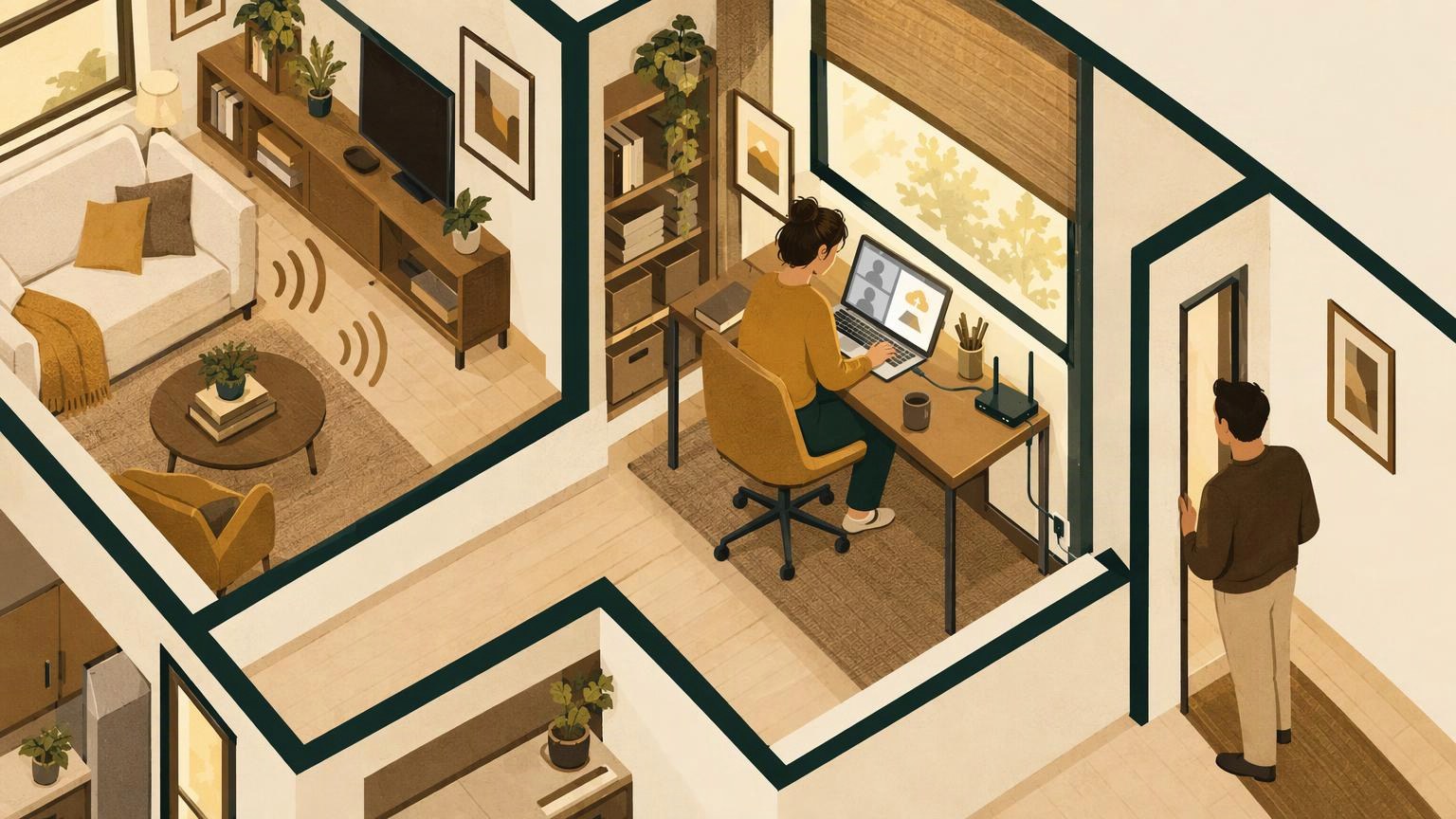
Illustration of a home workspace beside a shared living room, with a laptop, wired router, and sound-wave marks highlighting connectivity, noise, and privacy considerations.
Prepare family routines and care continuity
When moving to Mexico with family, give each person's needs a place in the plan. A home that suits the adults may still create an impractical school routine or leave someone without regular social contact.
- For education, ask individual schools about current admissions, language of instruction, calendars, records, and support relevant to your child.
- For community, identify activities you would attend repeatedly rather than only during a visit.
- For household coordination, assign responsibility for appointments, records, errands, and communication.
- For language preparation, practice the conversations you expect to use in daily life.
Healthcare and insurance require their own professional review. Qualified medical and insurance professionals can address care continuity, prescriptions, records, coverage, exclusions, and emergency arrangements for your circumstances.
For planning purposes, keep contact details, records, and questions organized so those discussions are specific. Carry professionally reviewed costs and arrangements into the household budget and arrival plan.
Everyday wellness can also mean having a routine, opportunities for movement, and community participation. Those are lifestyle considerations, not promises of a medical or longevity outcome.
Coordinate belongings, shipping, and vehicles
Start with an inventory before requesting transport arrangements. Group belongings into what you need on arrival, what could travel later, what can remain in storage, and what you no longer need.
The distinction helps you compare the inconvenience of leaving something behind with the cost and effort of moving it. Sentimental items and bulky furniture may deserve different treatment even when both fit in the same shipment.
- Record item descriptions, condition, and photographs for household planning and provider discussions.
- Separate essential documents, work equipment, and arrival necessities from the main shipment.
- Compare written quotes against the same inventory and the same requested services.
- Identify who handles packing, transport, delivery, storage, and each handoff.
For menaje de casa, household-goods import, and vehicle questions, qualified independent customs or legal professionals can explain the current requirements and their relationship to your circumstances. A household inventory is useful preparation, but it does not establish customs eligibility.
Keep a vehicle in a separate planning category. Its documentation, transport, legal, and insurance questions need review rather than being treated as another household item.
The key dependency is the receiving arrangement. Dispatching belongings before suitable housing and the relevant professional questions are settled can create storage and coordination problems that a transport quote alone does not resolve.
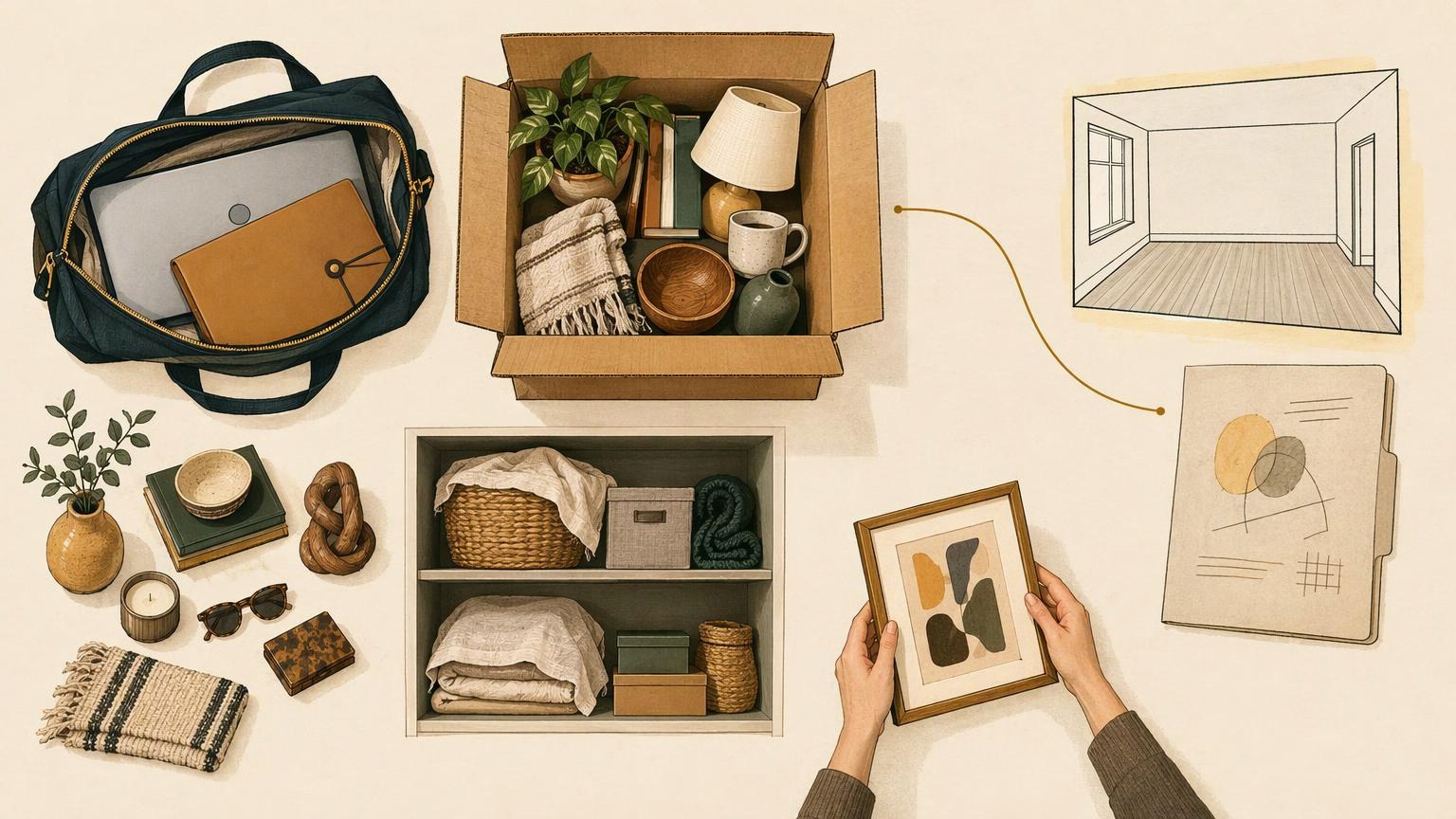
Illustration of household belongings grouped in a bag, open carton, shelving niche and separate cluster, with hands holding framed abstract art. An ochre line stops short of an empty-room sketch and a folder with abstract marks.
Put the tasks in a workable order
Order the move around dependencies, not an invented universal timeline. Give each task an owner and identify what must happen before it can be completed.
Say you and your partner want coastal living, but one of you works remotely and your furniture is still in the US. You are comparing a furnished arrival rental with moving directly into a longer-term home.
The furnished option lets you test workspace, connectivity, and neighborhood routine before deciding which belongings to bring. It may involve another move, storage, and extra purchases. The longer-term option reduces repeat setup, but only helps if the address, terms, work arrangements, and receiving plan are already understood.
In that situation, address-level internet and workspace testing should come before treating either home as workable. Shipping decisions follow the housing choice and qualified customs review, rather than setting the pace for everything else.
- Complete the household brief and destination comparison.
- Organize the independent professional discussions that affect the plan.
- Evaluate the receiving home, daily services, and connectivity.
- Coordinate transport and arrival responsibilities once the relevant dependencies are understood.
Use a task sheet with an owner, dependency, next action, and review date. Progress means a decision has enough support to move forward, not merely that another box has been checked.