
Mexico retirement visa and residency: requirements and steps
Mexico retirement residency planning involves comparing temporary and permanent categories, documenting eligibility and financial evidence, and distinguishing the consular visa stage from residency formalities in Mexico; qualified independent immigration professionals can explain applicable requirements. The Mexican Consulate in Orlando's Permanent Resident Visa (Retirement) checklist has an unverified publication date and does not establish current San Diego requirements. This is general educational information, not immigration advice. Next recheck: December 12, 2026.
Table of Contents
- What does a Mexico retirement visa application involve?
- How should you compare temporary and permanent residency?
- Financial eligibility is different from retirement affordability
- Documents should tell a coherent story
- Consular appointments and the INM stage serve different purposes
- A worked example: destination certainty and residency uncertainty
- Where The Golden Life fits in the plan
- Frequently Asked Questions
Retirement planning and immigration planning overlap, but they answer different questions. Your preferred destination explains where you might want to live; it does not establish permission to live there.
The Mexican Consulate in Orlando's Permanent Resident Visa (Retirement) checklist is an official document reference, not a substitute for current instructions applicable to your application. This article provides general educational information, not professional advice. For the broader lifestyle decision, The Golden Life's live and retire in Mexico planning hub connects residency questions with everyday living and relocation priorities.
What does a Mexico retirement visa application involve?
The useful starting point is the distinction between a reason for moving and an immigration category. Retirement describes your intended life in Mexico; temporary or permanent residency describes the status being considered. A qualified independent immigration professional can explain which category and application basis may apply to your circumstances.
For planning purposes, separate the route being considered, the evidence supporting it, and the administrative stages involved. These are connected, but resolving one does not resolve the others. Having financial records ready, for example, does not establish that the correct application category has been identified.
Another distinction is between a consular visa and residency documentation handled in Mexico. The process is commonly discussed as a consular stage followed by a Mexico-side stage. The applicable sequence, entry formalities, and deadlines belong in a current official explanation reviewed with an immigration professional.
This matters because travel plans can become tied to an incomplete understanding of the process. An appointment, an issued document, and completion of the relevant residency formalities are different milestones. A retirement plan should describe which milestone a particular housing or travel decision depends on, rather than calling the entire process simply approved.
How should you compare temporary and permanent residency?
Temporary and permanent residency are different categories, not interchangeable labels for a retiree application. Whether either is available to a particular applicant requires current official requirements and an individual professional assessment. Neither the wish to retire nor a preference for fewer administrative steps determines eligibility.
A useful comparison considers intended use, the application basis, and the obligations attached to the resulting status. The table below frames that discussion without assigning a route to your case or quoting unverified rules.
| Planning option | Question it addresses | Professional clarification needed | Planning trade-off |
|---|---|---|---|
| Exploratory visit | Would everyday life in Mexico suit you? | Current entry conditions and permitted stay for the proposed visit | Can inform destination choice, but does not establish a residency route |
| Temporary residency | Is a temporary resident category applicable to the intended stay? | Eligibility, duration, renewal obligations, and permitted activities | The plan needs room for any applicable future administrative steps |
| Permanent residency | Is a permanent resident category available for the applicant? | Application basis, eligibility, documentation, and continuing obligations | A preference for permanent status cannot replace qualifying evidence |
Retirement plans do not settle retirement criteria
Someone leaving work early may use the word retired while holding savings rather than a pension. Someone else may receive retirement income while continuing some work. Those descriptions explain a person's life, but they do not establish how an official category treats that person's circumstances.
An immigration professional can distinguish intention, income type, and any applicable retirement criteria. That is more useful than applying an age rule or a definition of retirement found in someone else's experience.
Permission questions belong alongside lifestyle questions
Seasonal living, a full relocation, and a second home can lead to different planning questions. The intended activities also matter, including any work or rental use. The appropriate professional discussion should cover those activities rather than assuming that a resident label answers every permission question.
Financial eligibility is different from retirement affordability
A financial eligibility test concerns the evidence accepted for a particular immigration route. A retirement budget concerns what your chosen life will cost. A figure that appears comfortable for everyday spending is not proof of eligibility, and evidence sufficient for an application does not establish that your lifestyle will be affordable.
This distinction prevents a common planning error: comparing monthly spending with a financial requirement as though both measure the same thing. Income, account balances, and documentation history may raise different questions. Their treatment requires the applicable official instructions, not an assumption that all resources are interchangeable.
For educational planning, financial records can be organized by what they demonstrate. Pension statements may explain a recurring payment; bank or investment records may explain balances or distributions. Whether any particular record is acceptable, and over what period, is a consular and professional verification question.
The personal budget has a different structure. Housing, utilities, transportation, healthcare, insurance, and visits to family belong in the living-cost discussion. Moving expenses and application-related costs belong in a separate transition budget so that they do not disappear into an ordinary monthly estimate.
There is also a liquidity question. Money allocated to a property purchase, money retained for living expenses, and money documented for an application may overlap in your plans. A qualified independent financial professional can examine that overlap, while an immigration professional explains the evidence requirements. This article does not recommend transfers, withdrawals, or asset changes.
Why a single national income figure can mislead
A financial number is useful only with its issuing authority, application category, effective date, and evidence instructions. Without those details, it can look precise while answering the wrong question.
The relevant comparison is not which online figure is lowest. It is which current official requirement applies, how that requirement is documented, and whether a qualified professional identifies any other material eligibility issue.
| Planning area | Purpose | Examples |
|---|---|---|
| Eligibility | Evidence accepted for a residency route | Pension, bank, or investment records |
| Living budget | Recurring everyday costs | Housing, transport, healthcare, insurance |
| Transition budget | Costs separate from monthly spending | Moving and application-related expenses |
| Liquidity | Resources that may overlap in your plan | Property, living costs, application funds |

Illustration with separate areas labeled Financial evidence and Living budget, pairing abstract papers and a magnifying glass with a blank notebook surrounded by everyday-budget objects.
Documents should tell a coherent story
Document preparation is more than collecting a large folder. Each record has a purpose: identifying the applicant, explaining the application basis, or supporting a fact the authority needs to assess. Current consular instructions establish the actual required documents and specifications.
A useful preparation file connects each requirement to the record intended to support it. That makes the difference between a missing document and an unanswered question visible. A statement can be present yet still leave uncertainty about whose account it is, what payment it records, or whether it covers the required period.
Names, dates, account ownership, and descriptions of income are useful matters for professional review. They should be understood accurately rather than interpreted optimistically. A joint account, for example, raises an attribution question; it does not establish how resources will be treated for separate applicants.
Translations, certifications, copies, photographs, and document formats are also specification questions. They should not be purchased merely because another applicant used them. The applicable official checklist and independent professional guidance determine what is needed.
Keep administrative evidence separate from substantive evidence. An appointment confirmation explains when a meeting is arranged. It does not prove financial eligibility. A financial statement supports information about resources, but it does not prove that an appointment or application has been accepted.
Consular appointments and the INM stage serve different purposes
Questions about how to get residency in Mexico should distinguish the application discussion outside Mexico from the residency formalities handled within Mexico. INM is Mexico's National Immigration Institute. An independent immigration professional can explain the current procedures applicable to the route being considered.
For the consular stage, the material questions concern the application category, appointment method, documents, interview, payment instructions, and any conditions attached to an issued visa. For the Mexico-side stage, they concern entry documentation, the relevant procedure, filing requirements, and completion of residency documentation.
The term canje often appears in explanations of exchanging a consular residency visa for a resident card. Understanding that vocabulary is helpful, but it is not a filing instruction. The current official procedure, deadline, and travel implications require professional confirmation.
An INM appointment in Mexico should therefore be understood within the larger process. Obtaining an appointment is not the same as completing a filing, and completing a filing is not necessarily the same as receiving the final documentation. The professional explanation should identify those milestones clearly.
The practical downside is that housing and travel preferences may not fit neatly around administrative steps. A fixed return ticket, a move-in commitment, or a plan to bring belongings can create dependencies. Rather than assuming a processing time, a planning calendar can distinguish confirmed dates from dates that depend on official action.
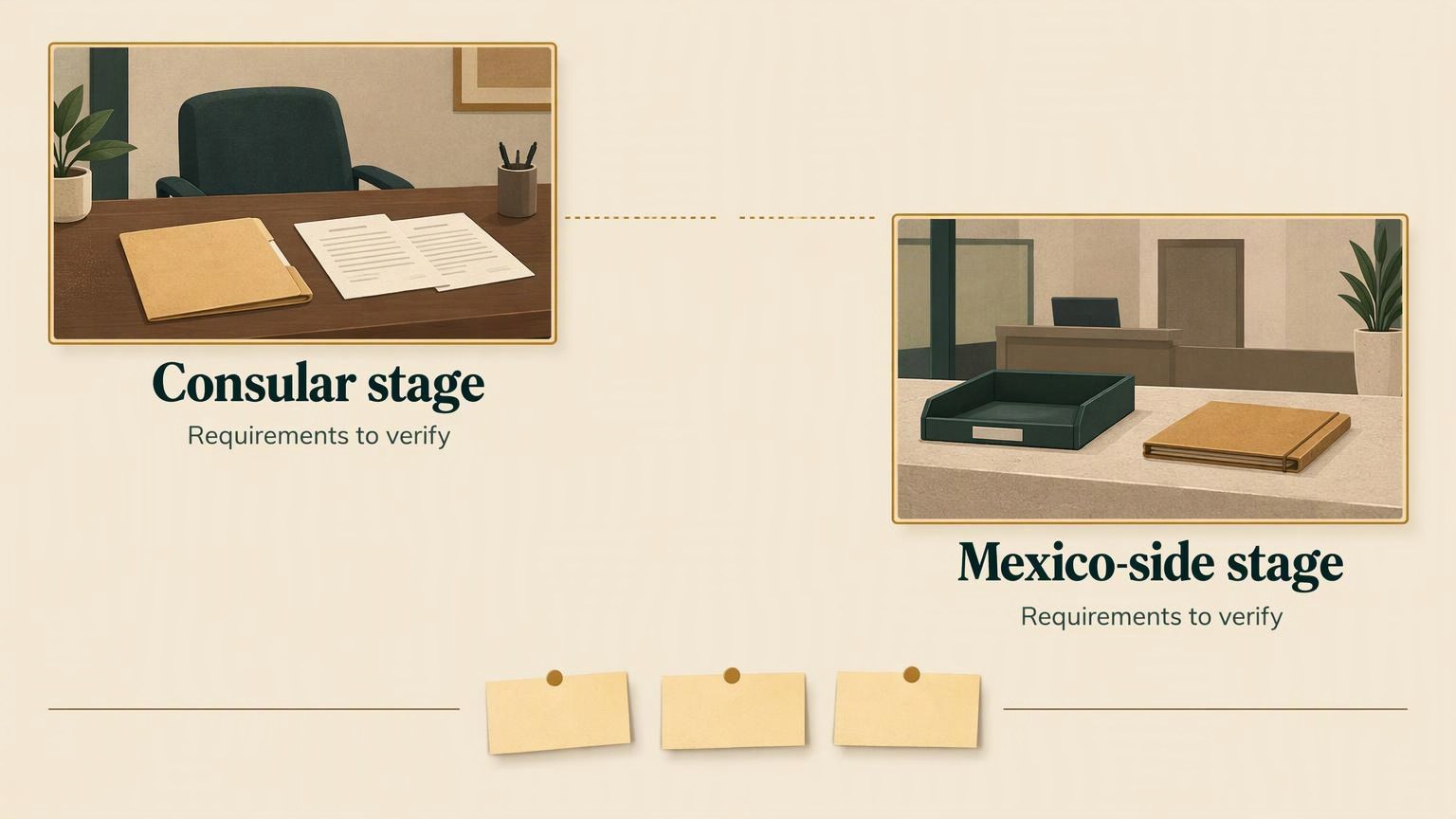
Illustration of distinct consular and Mexico-side stages, each labeled Requirements to verify, with empty administrative settings, a dotted connector with a central gap, and three blank planning tabs.
A worked example: destination certainty and residency uncertainty
Say you have stopped working, receive regular retirement income, and want to relocate to Mexico. You like Puerto Vallarta's mountain-framed bay, established international community, neighborhood character, and everyday city services. You have not yet had your eligibility or financial records assessed.
There are different decisions here. The destination preference has a concrete basis. The immigration route does not yet have the same level of certainty. Treating enthusiasm for the destination as a reason to accelerate a property commitment would combine decisions that need different evidence.
An exploratory visit could inform whether ordinary life suits you, subject to current entry requirements reviewed with an immigration professional. A temporary residency discussion would address whether that category applies and what obligations follow. A permanent residency discussion would address its own eligibility basis, rather than assuming retirement income settles the question.
The conclusion is not that one category is universally better. It is that destination investigation can have a clear purpose while the immigration assessment remains a separate professional task. A lifestyle visit cannot establish residency eligibility, and an eligibility assessment cannot tell you whether you enjoy the neighborhood on an ordinary day.
This separation also helps explain the housing trade-off. Renting can preserve flexibility in the lifestyle decision; purchasing creates a separate transaction that requires independent legal, tax, technical, and financial review. Neither option should be treated as a substitute for establishing the applicable immigration route.
Where The Golden Life fits in the plan
The Golden Life provides destination and property guidance for Americans considering retirement, relocation, a second home, or investment in Mexico. Its process begins with your objective, then considers budget, timing, access, wellness, and community priorities. That is a planning role, not a determination of immigration eligibility.
For a retirement decision, this helps separate what you want from what requires professional verification. A destination may fit your preferred pace and community while the immigration route, healthcare arrangements, and transaction questions still require independent specialist input.
An inquiry to The Golden Life is a way to talk through the questions that matter before investing time or money. You can request a An inquiry to The Golden Life to discuss destination and property direction while keeping immigration advice with an appropriately qualified independent professional.
If your destination preferences are still broad, the Find your place lets you share your priorities and send an inquiry. It does not establish visa eligibility, approval, financing terms, or property availability.