
How to retire in Mexico: costs and first steps

To plan retirement in Mexico, define whether you want full-time or part-time living, build a dated budget for a specific household and destination, and compare that plan with your available income. Keep setup costs and retained U.S. expenses separate. Explore everyday life before committing to housing, and use qualified independent professionals to evaluate residency, taxes, healthcare, insurance, and any property transaction.
Table of Contents
- How much money do you need to retire in Mexico?
- Which costs sit outside monthly living expenses?
- Which destination fits your ordinary life?
- Living affordability and residency are separate questions
- Should you rent, buy, or divide your time?
- What should an exploratory stay help you learn?
- Turn the first steps into a decision you can revisit
- Frequently Asked Questions
The question of how to retire in Mexico has two parts: whether the life suits you and whether the complete plan works financially. A rent figure alone cannot answer either one.
Your budget needs a household size, a destination, a housing arrangement, and a date. It also needs the expenses that follow you across the border, such as commitments in the United States and visits to family. Begin with those details, then evaluate the practical and professional questions that could change the plan. A vacation impression is useful, but it is only the beginning.
How much money do you need to retire in Mexico?
You need enough for your own complete spending basket, plus setup expenses and money available for unexpected needs. There is no universal monthly amount that establishes a comfortable retirement across Mexico.
A useful published budget names the household, location, housing type, and date. Kerry Baker's household cost examples published by Sixty and Me on November 11, 2020 illustrate that approach. The selected figures below are historical U.S. dollar amounts, not November 2026 prices, current quotes, or a recommendation to live in either city.
The comparison shows why household details matter. The single-person example has higher rent than the couple's example, while the couple spends more on food. Household size alone does not determine the total.
| Expense | Mérida: couple | Mazatlán: single person |
|---|---|---|
| Rent | $825, two-bedroom apartment in an upscale area | $850, two-bedroom apartment near the beach |
| Food | $500 | $300 |
| Internet | $35 | $40 |
| Phone | $100, U.S. plan | $25, phone service |
| Utilities or electricity | $60, utilities | $50, electricity |
Turn the basket into your own estimate
Use the categories as a starting structure, rather than updating the old figures by an assumed percentage. Obtain dated prices for the housing arrangement and services you are actually considering, with the currency recorded beside each amount.
Add transportation, meals out, household purchases, leisure, insurance, and healthcare amounts established with appropriate providers and professionals. Include family travel and U.S. expenses that will continue. Mark each entry as a quote, an observed expense, or an estimate so you can see how dependable the total is.
Keep monthly and annual costs distinct, then convert annual expenses into a monthly planning allowance. A budget that excludes travel or renewals may look affordable until those bills arrive.
Which costs sit outside monthly living expenses?
Separate the cost of living in Mexico from the cost of establishing a life there. Combining everything into one monthly figure can hide how much money you need before the routine begins.
Organize the plan into recurring spending, one-time setup spending, and funds kept available. These have different purposes, even when they come from the same savings account.
Setup and overlapping households
Possible setup categories include travel, temporary accommodation, moving or storage, household essentials, and professional services. Housing agreements may also involve upfront payments whose amount and treatment depend on the specific agreement.
During a transition, you may be supporting accommodation in Mexico while still paying for a U.S. home. Compare the overlap period separately rather than assuming every American expense disappears on arrival.
For part-time retirement, keep both sides of the household visible. A lower grocery bill in Mexico cannot offset expenses you have accidentally left out of the comparison.
Currency and accessible funds
A budget funded in U.S. dollars but spent partly in Mexican pesos needs a dated conversion assumption. Record the exchange rate and any transfer charges used in your calculation, rather than mixing currencies in the same total.
Also distinguish assets from money available for spending. A property or investment balance is not the same as accessible funds for an unexpected expense. A qualified independent financial professional can help evaluate cash flow, reserves, and the effect of exchange-rate changes on your circumstances.
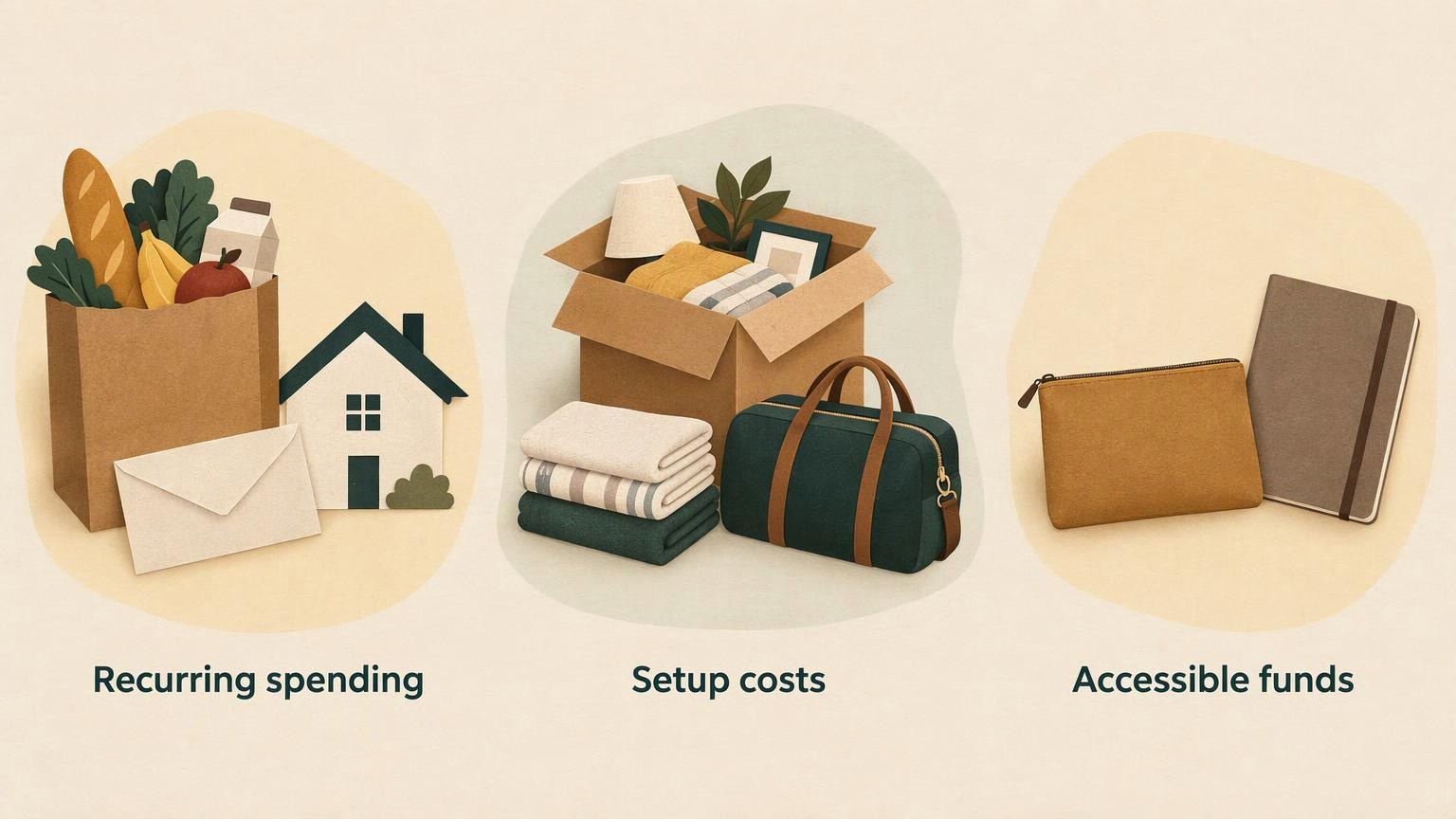
Illustration of three separate budget categories: Recurring spending, Setup costs and Accessible funds, represented by household items, moving supplies, and a pouch with a notebook.
Which destination fits your ordinary life?
Choose the routines you want before choosing the scenery. Consider whether you want an established city community, a residential coastal setting, or an amenity-centered lifestyle.
The Golden Life's Mexico destination guides include the following starting points. They are not a complete market comparison or a ranking of the cheapest, safest, or healthiest places.
| Destination | Distinctive setting | Why it might fit | Decision to test |
|---|---|---|---|
| Riviera Maya | Mexican Caribbean coastline and growing residential communities | You want coastal living with an international-access dimension | Whether a particular residential community supports your errands and social routine |
| Los Cabos | Desert landscape, the Sea of Cortez, marina life, and golf | You value polished amenities and those leisure activities | Whether your regular use of amenities belongs in the retirement budget |
| Puerto Vallarta | Mountain-framed Pacific bay, neighborhood character, and an established international community | You want everyday city services alongside a coastal setting | Whether the neighborhood rhythm and housing setting suit ordinary days |
Living affordability and residency are separate questions
Your spending budget answers whether the lifestyle is financially plausible. It does not establish whether you qualify for a particular immigration status.
For residency planning, an appropriately qualified independent immigration professional can assess the current route, evidence, application steps, and timing relevant to your circumstances. A household's reported living costs are not a substitute for that assessment.
The same separation applies to Social Security. If you are considering retiring in Mexico on Social Security, compare your own expected available income with the complete spending basket. Questions about benefit administration, payment arrangements, and reporting belong with the responsible agency and qualified professionals.
Tax treatment is another independent part of the plan. A cross-border tax professional can evaluate your income sources, living arrangements, and obligations. Neither a modest budget nor a part-time arrangement establishes a tax outcome.
For broader context on living and retiring in Mexico, explore The Golden Life's Retire or Relocate to Mexico hub. Keep that lifestyle planning separate from an independent assessment of residency eligibility.
This article is general educational information, not immigration, tax, financial, medical, legal, or investment advice.
Should you rent, buy, or divide your time?
The useful comparison is how much commitment each arrangement requires while you are still learning about the destination. A housing decision should follow the questions that could change where, how, or whether you want to live.
| Arrangement | What it lets you learn | Trade-off | Budget focus |
|---|---|---|---|
| Rent while exploring | Neighborhood routine and suitability without a purchase | Rental terms and future housing remain part of the plan | Rent, upfront payments, utilities, and any temporary overlap |
| Buy after evaluating fit | Plan around a particular property and location | Ownership adds a transaction and ongoing responsibilities | Acquisition, ongoing property costs, maintenance, and independent review |
| Divide time between countries | Experience Mexico while retaining a U.S. base | Two households and repeated travel can remain in the budget | Costs in both countries and travel between them |
A choice worked through
Say you are retiring as a couple. You enjoy coastal life, but you have not settled how much time to spend in Mexico, and you expect regular visits to family in the United States.
Buying immediately would tie the plan to a property before the annual routine is clear. Renting offers a way to learn about ordinary days, while part-time living lets you compare the experience without giving up the U.S. base. The latter also retains more household expenses.
For that situation, exploring through a rental fits the unanswered lifestyle question better than starting with a purchase search. If you later establish a stable routine and want ownership, the comparison can shift to property costs and independent transaction review.
Keep ownership questions distinct
Americans can own property in Mexico, but the ownership structure depends on location and circumstances, including special structures in restricted coastal and border zones. Use qualified independent legal and tax professionals for any transaction.
Do not treat buying a home as proof of residency eligibility or as a guaranteed financial result. Property suitability, ownership structure, and immigration status require separate evaluation.
| Arrangement | Trade-off | Budget focus |
|---|---|---|
| Rent while exploring | Rental terms and future housing | Rent, upfront payments, utilities, overlap |
| Buy after evaluating fit | Transaction and ongoing responsibilities | Acquisition, upkeep, independent review |
| Divide time between countries | Two households and repeated travel | Costs in both countries and travel |
What should an exploratory stay help you learn?
An exploratory stay is most useful when it tests the parts of retirement that a vacation leaves out. That includes preparing meals, buying household essentials, doing errands, and spending unstructured time in the neighborhood.
Record actual spending by category and note what the accommodation price includes. A furnished temporary stay and a longer-term housing agreement are different products; one price should not silently stand in for the other.
Observe building access, noise, transport dependence, and how you spend time without a planned activity. Consider whether your routine works when you are tired, carrying groceries, or staying home rather than going out.
Healthcare and insurance require professional evaluation, not impressions from a visit. Qualified independent medical and insurance professionals can assess your care needs, medication arrangements, coverage, exclusions, and emergency planning. A destination's appeal does not establish an appropriate care plan.
For safety and travel questions, use current official guidance and qualified local expertise. Avoid converting a pleasant stay into a blanket assurance about future conditions.

Illustration of an older couple returning with groceries beside entrance steps and a handrail, with a kitchen counter inside and a neighborhood shop and bus beyond.
Turn the first steps into a decision you can revisit
Start with a short written description of the retirement you want: full-time or part-time, the household involved, the routines you value, and the commitments you intend to retain. This gives the budget a purpose.
Next, build a dated basket for a specific destination and housing arrangement. Keep estimated amounts visible, add setup spending separately, and identify the professional questions that could materially change the plan.
Then use an exploratory stay to test the largest lifestyle assumptions. You are looking for evidence that changes a decision, such as discovering that you depend on paid transport more than expected or prefer a different neighborhood rhythm.
The Golden Life connects destination and property direction to those priorities. Its Find your place start lets you share your priorities and send an inquiry. That is a way to organize the next stage of exploration, not an approval or a promise of property availability.