
Health insurance for expats in Mexico: understanding IMSS access

Health insurance for expats in Mexico involves separate questions about eligibility, enrollment, and access to services. IMSS is one avenue to investigate, alongside private insurance arrangements, but the appropriate route depends on current program rules and individual circumstances. IMSS and qualified independent insurance professionals can clarify requirements; a destination match does not establish insurance eligibility or active coverage.
Table of Contents
- Separate eligibility, enrollment, and usable access
- Which IMSS enrollment route is being discussed?
- Compare arrangements by access, not by a universal best plan
- What establishes that enrollment is complete?
- Evaluate everyday access separately from enrollment
- Say you plan to divide your time between Mexico and the United States
- How healthcare access connects to destination and property fit
- Frequently Asked Questions
A plan to live in Mexico can look settled while the insurance question remains open. Knowing the name of a program is different from knowing whether you can enroll, when an arrangement becomes active, and how you would access services where you expect to live.
This article keeps health insurance for expats in Mexico focused on access and enrollment, not treatment or health outcomes. It complements The Golden Life's retirement and relocation planning. The information is general education, not medical, insurance, immigration, legal, or financial advice; individual decisions require appropriately qualified independent professionals.
Separate eligibility, enrollment, and usable access
The first useful distinction is between permission to join an arrangement and evidence that it is active. A description aimed at foreign residents cannot determine an individual applicant's position, and a completed form cannot answer every question about accessing services.
Think of the decision as separate stages. Eligibility concerns whether the specific route is available to you; enrollment concerns whether the required process has been completed; usable access concerns how the arrangement works in the place where you live.
Those stages can require different explanations. IMSS is the authority for its program administration, while qualified independent insurance and immigration professionals can address questions within their respective fields.
Why the distinction changes a relocation decision
A destination can fit your preferred pace of life while an insurance question still needs an answer. That does not establish that the destination is unsuitable, but it does mean an assumed insurance arrangement should not be treated as settled.
For planning purposes, keep a distinction between an option you are investigating and an arrangement whose status has been confirmed. This prevents a general description of healthcare in Mexico for expats from carrying more weight than it can support.
The same distinction applies within a household. Shared relocation plans do not establish shared insurance eligibility, identical enrollment requirements, or identical access needs.
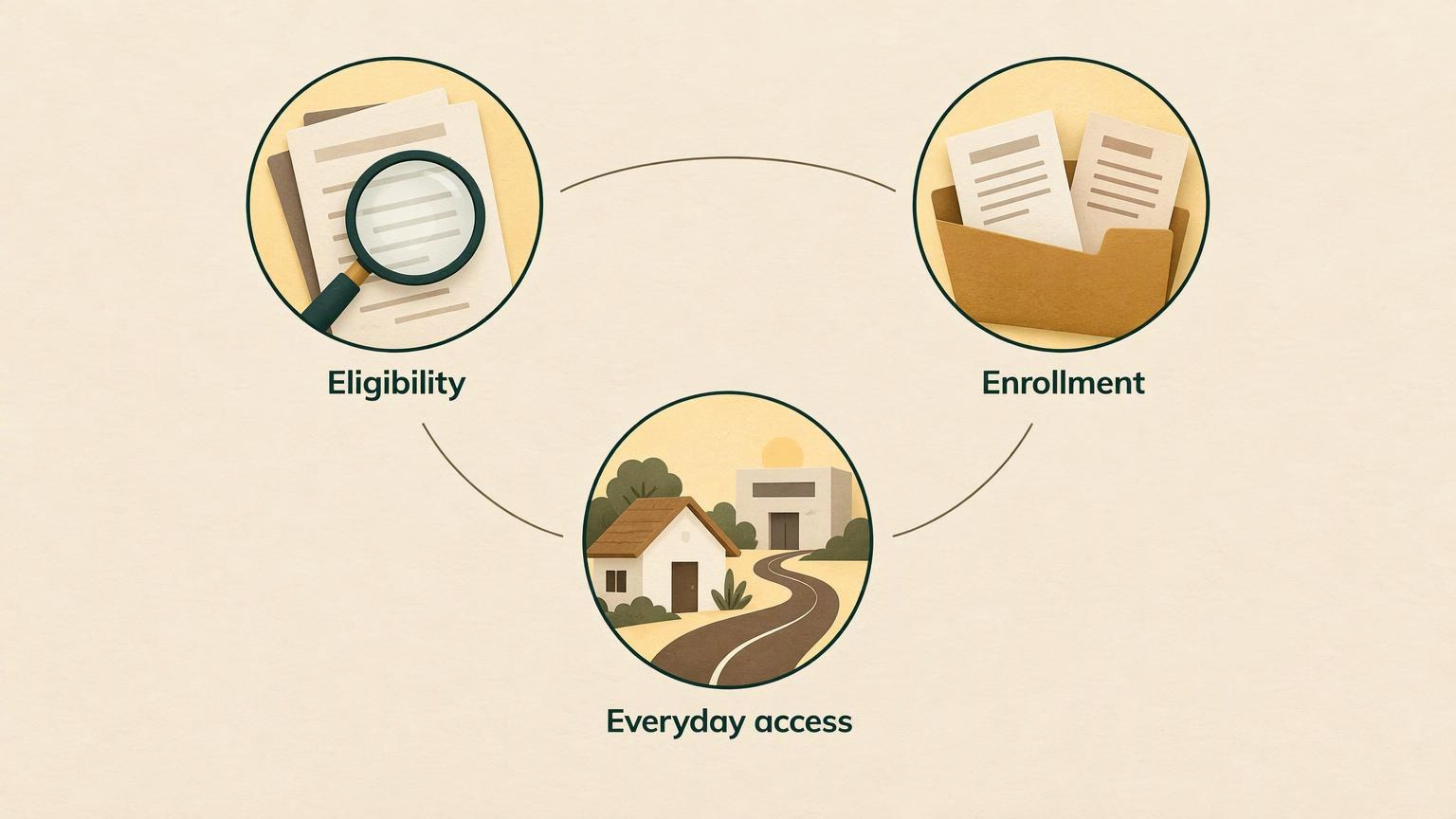
Illustration with three non-directionally connected vignettes labeled Eligibility, Enrollment, and Everyday access, showing papers, a folder, and a local street scene.
Which IMSS enrollment route is being discussed?
IMSS stands for Instituto Mexicano del Seguro Social. Before interpreting any enrollment explanation, establish the exact program or route it describes rather than relying on the broad label 'IMSS insurance.'
This overview provides general orientation, not a dated account of current official IMSS enrollment rules. It does not establish current requirements or individual eligibility.
For example, a discussion of employment-related enrollment and a discussion of voluntary enrollment raise different administrative questions. The name Seguro de Salud para la Familia also appears in explanations of voluntary access; it should not be treated as a substitute for identifying the current program and its rules.
Current eligibility, the relevance of residency or work circumstances, and the treatment of household members need clarification from IMSS and appropriately qualified independent professionals. A program-specific explanation grounded in dated official IMSS guidance is needed before these general distinctions can support an enrollment decision.
Keep the program name attached to the answer
A useful explanation identifies both the person it applies to and the program involved. Without that context, a statement about 'foreigners' or 'retirees' may be too broad to support an enrollment decision.
The same care applies to instructions shared by someone who enrolled previously. Their experience can suggest a question worth raising, but it cannot establish today's requirements for another person.
When discussing a route with IMSS or a qualified professional, the useful result is a program-specific explanation: what makes the route relevant, what must be established, and which authority makes the enrollment determination. An immigration professional can address status questions, but cannot replace IMSS's program decision.
Compare arrangements by access, not by a universal best plan
There is no responsible universal ranking of health insurance options for every American considering Mexico. The useful comparison is between the questions each arrangement needs to answer for the life you expect to lead.
Public enrollment, a private policy focused on Mexico, and an international private policy are different avenues to discuss with a qualified independent insurance professional. Their names alone do not establish eligibility, benefits, geographic scope, provider access, or suitability.
The table below compares decision questions, not verified benefits or recommendations. Any actual comparison needs current program terms or policy documents.
| Avenue to investigate | Eligibility question | Access question | Evidence needed |
|---|---|---|---|
| An identified IMSS enrollment route | Does the current program apply to the applicant? | How is service access established under that route? | Current IMSS requirements and enrollment confirmation |
| A private policy focused on Mexico | Will the insurer accept the application on the proposed terms? | Which providers and payment arrangements apply? | Policy wording, acceptance documents, and provider confirmation |
| An international private policy | Does the proposed residence and travel pattern fit the policy terms? | Which countries and services fall within the contract? | Territorial terms, policy wording, and acceptance documents |
The trade-off is administrative as well as financial
An arrangement that appears simple in a summary may require a different appointment or payment process than you expect. Conversely, wider geographic scope would not, by itself, answer whether a particular local provider is accessible under the terms.
A qualified insurance professional can explain how a proposed arrangement handles those questions. Comparing only a headline fee leaves out the part of insurance that matters when you need to use it.
| Avenue | Eligibility | Access | Evidence needed |
|---|---|---|---|
| Identified IMSS route | Does the program apply to the applicant? | How is service access established? | IMSS rules and enrollment confirmation |
| Mexico-focused private policy | Will the insurer accept the application? | Which providers and payment terms apply? | Policy, acceptance, provider confirmation |
| International private policy | Residence and travel fit policy terms? | Which countries and services are covered? | Territorial terms, wording, acceptance |
What establishes that enrollment is complete?
The answer comes from the relevant program or insurer's confirmation, not from an assumption based on submitting an application. A receipt, reference number, or payment record needs to be interpreted in the context of the route involved.
For IMSS, the appropriate administrative authority can explain what confirms enrollment and how to establish the applicable service status. For private insurance, the insurer and a qualified independent insurance professional can explain the meaning of acceptance documents and policy dates.
No start date or processing period is stated here. An individual planning timeline needs current confirmation rather than a date carried over from an older guide.
Distinguish administrative dates from benefit conditions
An application date, a payment date, and an effective date answer different questions. Even where an arrangement is active, the applicable terms still need to establish whether a particular service falls within it.
This is why 'enrolled' should not be used as shorthand for 'every service is available immediately.' IMSS or the relevant insurer must explain the current terms, including any conditions that affect access.
Keep personal information in the appropriate channel
Enrollment questions can involve identity, residency, household, and health information. The receiving institution or qualified professional should explain which information is required and the appropriate submission channel.
An inquiry to The Golden Life has a different purpose. It is not an insurance application, and it does not substitute for disclosures or documentation required by an insurance arrangement.
Evaluate everyday access separately from enrollment
Once an arrangement has been identified, the location question becomes more specific: how would you actually use it from the home or community you are considering? A destination's appeal does not answer that administrative question.
Relevant points include the service location, appointment process, language support, accessibility needs, and any referral or payment procedures that apply. Current details belong with the relevant institution, provider, and qualified professional rather than in a broad destination ranking.
Provider access and payment are different questions
Being able to make an appointment and knowing who pays for it are separate matters. When evaluating a private arrangement, a useful discussion distinguishes provider participation, authorization requirements, direct payment, and reimbursement under the actual policy.
For an IMSS route, the corresponding question is how service access is organized for the enrolled person. Neither discussion should assume that an insurance document grants unrestricted access to any facility.
The practical comparison is about the steps involved in using the arrangement, not a claim that one system delivers better care. Treatment choices and personal health decisions remain matters for qualified medical professionals.
Language and mobility belong in the access discussion
Language preferences and mobility needs can change which questions matter most. A reader comfortable handling administrative conversations in Spanish may have different planning priorities from someone who needs interpretation support.
No language service or accessible facility is promised here. Those details require confirmation at the actual location; destination-level descriptions are too broad to establish them.
Say you plan to divide your time between Mexico and the United States
Say you are considering a second home in Mexico while keeping an established routine in the United States. Your partner expects to spend more time in Mexico than you do, so the household has a shared destination choice but different access questions.
An IMSS route might be one avenue to investigate, but its name does not establish either person's eligibility or address services outside Mexico. A Mexico-focused private policy would need its actual territorial terms examined, while an international policy would need confirmation of the proposed residence and travel pattern.
The decision does not follow automatically from spending more or less time in Mexico. It follows from the current rules, each person's circumstances, and the documented scope of the arrangements being compared.
If qualified guidance establishes that an option does not address the intended access needs, that option does not solve the entire planning question. A wider-sounding policy name is not enough either; its contract still has to answer the relevant questions.
The useful outcome is a person-by-person explanation of access, including what remains separate between countries. This allows the household to evaluate the destination without pretending that one enrollment decision settles everything for both people.

Overhead illustration of two separate planning boards with location markers and travel lines, a labeled United States–Mexico map and a house token between the boards.
How healthcare access connects to destination and property fit
The Golden Life provides destination and property guidance for Americans considering retirement, relocation, a second home, or investment in Mexico. Its relevance here is the connection between everyday-life priorities and where you might live, not the determination of insurance eligibility.
A property preference can change after the access discussion becomes concrete. Someone who values simpler access to daily services may assess a community differently from someone whose priority is a quieter setting and who is comfortable investigating the associated transport arrangements.
The Golden Life's process begins with the intended use of the move or property, then considers budget, timing, access, wellness, and community priorities. Healthcare access belongs in that comparison as a practical question; wellness is a lifestyle framework, not a medical promise.
The Find your place lets you share your priorities and send an inquiry. It does not establish insurance acceptance, residency eligibility, or property availability.