
Fideicomiso in Mexico: how the bank trust works and what it costs
A fideicomiso in Mexico is a bank trust used in certain property ownership arrangements: the bank holds legal title, while the beneficiary has rights defined by the agreement. The appropriate structure depends on location and circumstances. Costs can include establishment, recurring administration, and later transaction charges. A meaningful total requires dated, itemized bank and notary quotes, separate from other purchase and ownership expenses.
Table of Contents
- What does the bank actually do?
- How does location affect the ownership question?
- How much does a fideicomiso cost?
- How do a new trust and an existing trust differ?
- Which ongoing terms matter beyond the annual fee?
- What does the trust not protect you from?
- A practical comparison: a lifestyle fit and an incomplete quote
- Bring a clearer brief to the property conversation
- Frequently Asked Questions
For an American considering a home in Mexico, the unfamiliar word is often less important than the practical question: what will you control, and what will you pay? A fideicomiso in Mexico separates the bank's title-holding role from the beneficiary's rights, so the agreement matters as much as the label.
This is general educational information, not legal, tax, financing, or investment advice. The Golden Life's second-home and investment planning hub provides broader context; qualified independent professionals are needed to evaluate any particular property, ownership arrangement, or transaction.
What does the bank actually do?
In a property fideicomiso, the bank acts as trustee and holds legal title under a trust agreement. The buyer's interest is expressed through beneficiary rights rather than the same title arrangement the buyer may know from a U.S. home purchase.
That distinction does not mean the bank is your landlord. It means the legal documents separate title holding, beneficiary rights, and the instructions the trustee can act upon.
The agreement identifies the property and the beneficiaries, sets the bank's administrative responsibilities, and addresses actions involving the trust. Questions about who may issue instructions, which actions require formal documentation, and how administrative charges change belong in the contract review.
A buyer may be interested in personal use, rental use, improvements, or an eventual sale. Those intentions are useful starting points for an independent lawyer's review, but a general description of a fideicomiso is not confirmation that every intended activity is permitted for a specific property.
Title holding is different from property management
The trustee's role should not be confused with maintaining the home or managing rentals. A bank trust agreement is not, by itself, a property-management agreement, insurance policy, or promise that the home will produce income.
The practical distinction is responsibility. The trust addresses the ownership arrangement; separate contracts and applicable requirements govern services and activities involving the home.
How does location affect the ownership question?
Americans can own property in Mexico. The ownership structure depends on location and circumstances, including special structures in restricted coastal and border zones.
A destination name is a starting point, not a legal determination about a parcel. An independent legal review considers the registered property, its location, its intended use, and the proposed ownership documents.
This matters when comparing the Caribbean coastline and growing residential communities of Riviera Maya with Los Cabos, where desert landscape, marina life, and golf shape the lifestyle decision. Puerto Vallarta adds an established international community and everyday city services around a mountain-framed bay.
Those differences can help you choose where to explore. They do not establish the ownership arrangement for every home in those regions, and an ocean view is not the legal test.
The broader destination decision and the property-specific legal decision therefore remain separate. A place may suit your daily life while a particular property's documents or ownership structure do not suit the purchase you are considering.
How much does a fideicomiso cost?
There is no single useful total without knowing what the quote includes. Establishing a trust, administering it over time, and carrying out a later change are different services, so a headline amount can hide more than it explains.
This guide does not provide fee ranges because verified, dated bank or notary fee sources are not available for citation here. It explains cost categories, but does not yet answer how much those services cost. Undated estimates or broker comparisons are not substitutes for that evidence.
A reliable fee range identifies the bank or notary, the source date, the currency, the covered service, and relevant exclusions. For a particular purchase, current written, itemized bank and notary quotes establish the proposed charges; a published range is background information, not a transaction-specific quote.
The following categories explain how a trust budget is generally organized. They are not a fee schedule, and not every charge applies to every transaction.
| Category | When it may arise | What the quoted amount should distinguish |
|---|---|---|
| Trust establishment | When a new trust is created | Bank establishment services versus other closing expenses |
| Trust administration | During ownership | Billing period, currency, taxes, and fee-change provisions |
| Amendment or beneficiary change | When the trust arrangement changes | Bank charges versus legal or notarial work |
| Transfer, termination, or renewal | At a later transaction or contractual milestone | Applicable service charges and required documentation |
| Other purchase and ownership expenses | At closing and throughout ownership | Taxes, professional work, insurance, maintenance, and other separate expenses |
Compare scope before comparing totals
A quote labeled as a trust setup amount may cover only the bank's work. Another may bundle several services, which makes the totals difficult to compare until each component is identified.
Similarly, an annual administration charge is not an estimate of the home's annual operating cost. It sits alongside other expenses rather than replacing them.
A transparent comparison separates money due at purchase, recurring charges, and charges triggered by a later event. If an amount is described as all-inclusive, its exclusions still matter: the phrase alone does not explain whether taxes, registration, professional work, or future administration are covered.
| Category | When it arises | Check quote scope |
|---|---|---|
| Trust establishment | When creating a new trust | Bank services vs. other closing costs |
| Administration | During ownership | Billing period, currency, taxes |
| Amendment or beneficiary change | When the arrangement changes | Bank vs. legal or notarial charges |
| Transfer, termination or renewal | Later transaction or milestone | Service charges and required documents |
| Other property expenses | At closing and during ownership | Taxes, insurance, maintenance, legal work |
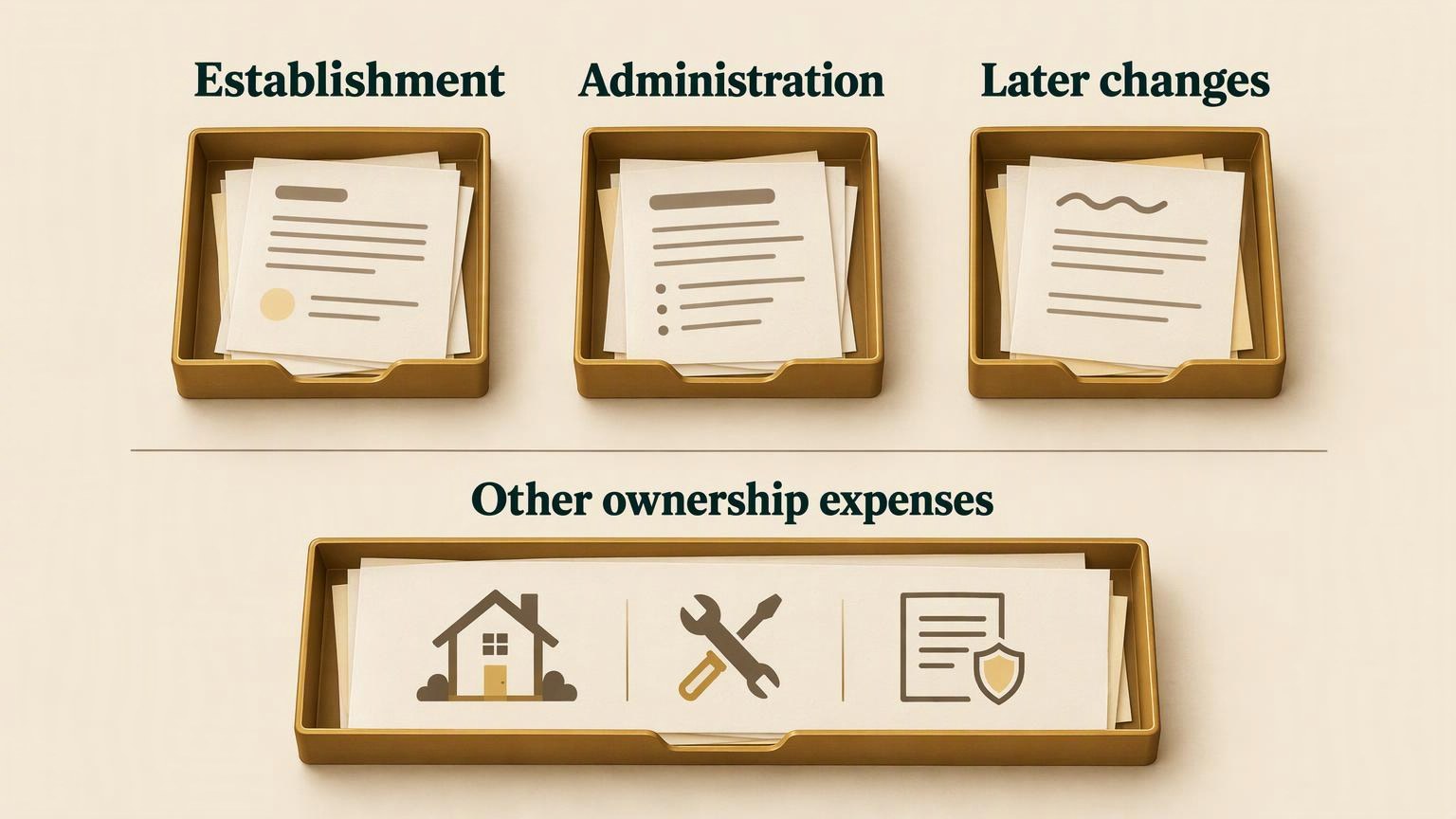
Illustration of three labeled paper trays separated by a fine rule from a wider Other ownership expenses tray containing house, tool and document-and-shield icons.
How do a new trust and an existing trust differ?
A seller's existing fideicomiso does not make the buyer's transaction automatic. The arrangement still needs review to establish how the proposed purchase would be documented and which bank, legal, and notarial steps apply.
With a new trust, the discussion centers on establishing the agreement and its administration. With an existing trust, the discussion also includes its current terms, remaining contractual duration, fee status, named beneficiaries, and the mechanism proposed for the buyer's interest.
These are different starting points, not a ranking. An existing arrangement may have useful documentation, but it can also carry terms or administrative questions that need attention.
The bank's familiarity with the property does not establish that the buyer has the same priorities as the seller. Intended use, successor planning, financing questions, and an eventual exit may all change what needs explanation.
A purchase proposal is also distinct from the completed ownership arrangement. A document described as a promesa de compraventa belongs in an independent legal review of the transaction; its name alone is not proof that title or beneficiary rights have already transferred.
The useful comparison is therefore the complete proposed path, including documents, responsibilities, costs, and dependencies. A lower establishment charge cannot answer whether that path is appropriate.
Which ongoing terms matter beyond the annual fee?
A recurring administration charge is easy to notice. Less visible terms may matter later, when a beneficiary changes, the property is sold, or a formal instruction requires supporting documents.
The agreement's duration and renewal provisions are separate from its billing schedule. Paying an annual charge should not be treated as an explanation of the trust's expiration date or the process for extending it.
Successor beneficiaries are another distinct topic. A trust may contain succession provisions, but their interaction with wills, family arrangements, and cross-border estate planning needs qualified independent legal and tax review.
For shared purchases, the relevant questions include whose instructions the trustee can accept and how changes are documented. Everyday agreement between buyers is not a substitute for understanding the formal arrangement.
Administration affects the ownership experience
Communication channels, invoice delivery, document access, and procedures for formal requests can affect how manageable the trust feels over time. These are service considerations to distinguish from the legal rights created by the agreement.
A comparison that focuses only on the lowest recurring charge can overlook how a later transaction will be handled. The downside of a bank trust is the added administrative relationship and its associated costs, even when the underlying property is otherwise a good lifestyle fit.
What does the trust not protect you from?
A fideicomiso is an ownership arrangement, not a blanket assurance about the property. It does not replace independent review of title, seller authority, permits, property condition, or the agreements connected with the purchase.
The presence of a trust also does not establish that a proposed rental use is permitted, that financing will be approved, or that a future sale will produce a particular return. Each is a separate question with its own documents and applicable requirements.
Title insurance in Mexico is another separate subject. A trust should not be described as title insurance, and any insurance proposal needs review of the actual policy, coverage, exclusions, and eligibility by qualified independent professionals.
This separation is especially useful when sales language combines several assurances into one sentence. A claim that the trust is ready says nothing, by itself, about a building's completion status or a promised rental outcome.
Financing may be available for qualified U.S. buyers through licensed providers. Eligibility, property requirements, underwriting, rates, terms, fees, and approval apply; The Golden Life's Mexico property financing overview provides educational context without establishing terms for a particular buyer.

Illustration of a trust agreement folder separated from property research papers, a magnifying glass, a house model and a rolled drawing on a warmly lit desk.
A practical comparison: a lifestyle fit and an incomplete quote
Say you are considering a second home in Puerto Vallarta because neighborhood character and everyday city services matter more to you than a resort setting. You expect personal use and want to understand the possibility of rental use later.
You receive one proposal that highlights a low trust establishment charge and another that separates establishment, recurring administration, and charges for later changes. No amount is needed to see the first comparison problem: the proposals describe different scopes.
The itemized proposal is easier to evaluate, but that does not automatically make it less expensive or legally preferable. The comparison becomes meaningful only when the same services, billing periods, currencies, and exclusions are placed side by side.
Your intended rental use remains a separate review topic. Neither a trust quote nor a destination's appeal establishes that the particular home can be used that way.
If ownership still depends on rental assumptions that have not been independently evaluated, continuing to explore the destination without committing to a purchase may better match your stage of planning. Buying now and waiting are meaningful alternatives; neither is universally better.
The Golden Life connects that lifestyle decision with destination and property direction. Its Find your place lets you share your priorities and send an inquiry, without implying approval, terms, or property availability.
Bring a clearer brief to the property conversation
A useful brief separates why you want the home from how a transaction might work. Retirement, relocation, second-home use, and investment can lead to different priorities even within the same destination.
That brief can describe the daily life you want, your intended use, budget considerations, timing, and the ownership questions that need independent professional review. It gives destination guidance a purpose without treating lifestyle preference as a legal conclusion.
The Golden Life's Next-Chapter Planner provides a planning framework before individual opportunities are compared. It is a broader planning resource, not a property-buying checklist. This article does not currently provide a buying-checklist download.
You can send a property inquiry to discuss your destination and intended-use priorities. That conversation can distinguish destination fit from transaction-specific work, rather than mixing them into a single promise.