
Condo HOA fees in Mexico: what you pay for and which rules matter

Condo HOA fees in Mexico generally fund shared operations and maintenance, but the amount, included services, reserves, and owner responsibilities depend on the building. Association rules also shape everyday use, including guests, rentals, pets, and alterations. A useful comparison examines the current budget, governing documents, repair obligations, and rules together, rather than treating a low monthly fee as proof of lower ownership costs.
Table of Contents
- What do condo maintenance fees actually cover?
- How can you compare fees without relying on a misleading range?
- What does the Mexico condo regime tell you?
- How do reserves and special assessments change the picture?
- Which association rules can change whether the condo fits?
- Which continuing responsibilities stay with the owner?
- How would this comparison work for a second-home buyer?
- Where does The Golden Life fit in this decision?
- Frequently Asked Questions
A condo can make shared maintenance easier to organize, but it also means living with collective spending decisions and community rules. When comparing condo HOA fees in Mexico, separate the services you receive from the expenses that remain yours.
For a retirement home, that might mean understanding upkeep while you are away. For a second home or rental-use property, guest access and occupancy rules may matter just as much as the bill. This is general educational information, not legal, tax, insurance, financial, or investment advice. Property-specific obligations require current documents and appropriately qualified independent professionals.
What do condo maintenance fees actually cover?
The fees commonly called HOA dues in English may appear as cuotas de mantenimiento in Mexican condominium information. They generally contribute to shared operations, such as cleaning common areas, maintaining landscaping, servicing shared equipment, and administering the building.
The useful distinction is between common-property expenses and private-unit expenses. Maintaining a communal pool is different from servicing the air conditioner inside your home. A building can handle the former without taking responsibility for the latter.
Some communities include certain utilities or shared services in their dues. Others bill those separately. The current budget and a written schedule of inclusions provide a better basis for comparison than a broad statement that maintenance is included.
Think of the fee as payment for a defined operating scope. A larger scope may suit you if it covers amenities you regularly use; it may feel wasteful if you are helping fund facilities that play little part in your daily life.
Separate access from service
A pool, gym, clubhouse, or other amenity appearing in property information does not by itself explain the terms of access. Distinguish an amenity included in the condominium's operations from a separate membership or service.
The same distinction applies to staffing. Common-area administration does not automatically include checking your private unit during an absence, managing guests, arranging repairs inside the home, or handling a rental.
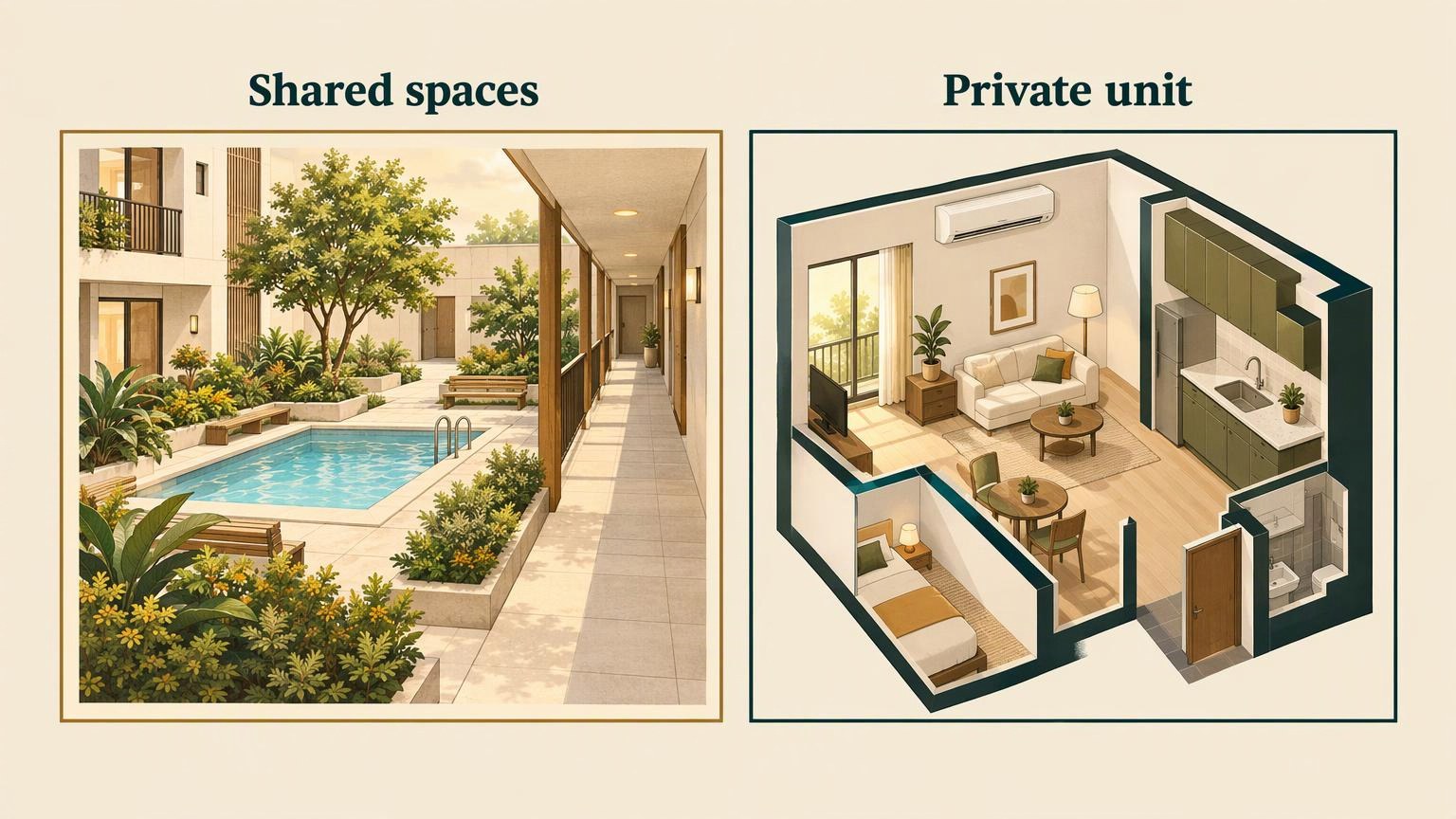
Illustration contrasting a shared courtyard, pool and corridor with a furnished private apartment cutaway, including an air conditioner and kitchen sink.
How can you compare fees without relying on a misleading range?
A national monthly range cannot tell you whether a particular condo is economical to operate. Building size, shared equipment, staffing, service scope, and the condition of common property all affect what owners are funding.
A meaningful fee comparison identifies the exact unit, the currency billed, the payment schedule, and the effective date. If an amount is presented in US dollars, distinguish a dollar-denominated obligation from a conversion of a peso-denominated charge.
A dated fee statement also needs context. Determine whether it reflects the current approved budget, an earlier operating period, or an estimate for a building that is not yet fully operating. An estimate and an established operating charge are different kinds of information.
For HOA fees in Puerto Vallarta, the relevant starting point is the individual building's budget and allocation method. Puerto Vallarta combines an established international community with neighborhood character and everyday city services, so a buyer's comparison may involve both residential routines and shared amenities.
For HOA fees in Los Cabos, separate the condominium's own services from any marina, golf, or other amenity access associated with the wider setting. Los Cabos is known for those lifestyle activities and polished amenities, but their presence in the region does not establish what a particular condo fee includes.
The fair comparison is the total cost of the services you expect to use, alongside the responsibilities left to you. A lower fee with important exclusions can be less suitable than a higher fee with a clear, relevant service scope.
What does the Mexico condo regime tell you?
The condominium regime is part of the framework for understanding private units, shared property, and participation in the condominium. It should not be treated as interchangeable with a sales brochure or a short summary of house rules.
For a buyer, the practical task is to understand how that framework connects to the unit being considered. Which areas belong to the unit, which are shared, and how are costs allocated? Those questions affect both continuing expenses and what you can use or change.
Documents may use different names or organize the information differently. An independent legal professional can explain the applicable documents, their legal effect, and any inconsistencies for the property and location.
| Record | What it helps you understand | Why it matters |
|---|---|---|
| Condominium regime and governing documents | Private and common property, participation, and governance framework | Connects the specific unit to shared rights and responsibilities |
| Current operating budget and fee schedule | Planned spending, charge allocation, billing currency, and payment schedule | Explains what the regular fee is intended to fund |
| Assembly minutes and financial reports | Recorded decisions, spending history, and discussed projects | Adds context that a current fee amount alone cannot provide |
| Rules and use policies | Occupancy, guests, amenities, alterations, and daily conduct | Shows whether the community fits your intended way of living |
| Maintenance records and technical reports | Condition, servicing, and identified repair needs | Helps distinguish appearance from documented upkeep |
Governance matters when you are away
A second-home owner may miss meetings or need information while outside Mexico. The governing documents can explain the applicable participation, notice, representation, and voting arrangements; do not assume they work exactly like those of a US association.
Also distinguish the administrator's operational role from decisions reserved to owners or other governing bodies. Knowing how decisions are made is useful when a budget changes or a major repair is proposed.
How do reserves and special assessments change the picture?
Regular dues support ongoing spending. Reserve funds are intended for future needs, while an extraordinary charge or special assessment addresses spending outside the ordinary fee arrangement. The building's documents determine how these mechanisms operate.
A special assessment is not automatically evidence of poor management. A substantial repair or equipment replacement may need separate funding. What matters is the reason for the charge, the supporting information, the approval process, and the payment obligation.
Conversely, a low regular fee does not establish that future work is funded. Financial reports and maintenance records help reveal whether the current charge is consistent with the building's operating and repair needs.
A reserve balance is also incomplete without context. Money on hand must be considered alongside commitments, planned work, and technical information about the condition of shared property.
Connect the accounts to the physical building
Consider a building with an attractive lobby but shared equipment approaching replacement. A tour may show cleanliness; it cannot establish the remaining service life of that equipment or whether replacement funding is adequate.
An independent technical professional can assess condition and repair needs. A qualified financial or legal professional can help interpret the related records and obligations. Neither a tidy appearance nor a reassuring fee amount substitutes for those separate forms of review.
| Funding | Purpose | What to review |
|---|---|---|
| Regular dues | Support ongoing spending | Operating budget and maintenance records |
| Reserve funds | Intended for future needs | Balance, commitments, and planned work |
| Special assessment | Spending outside ordinary fees | Reason, approval, and payment obligation |

Illustration of a desk with an open records folder, a magnified equipment schematic and reference images of a lobby and rooftop enclosure.
Which association rules can change whether the condo fits?
Mexico condo association rules deserve attention before a buyer becomes attached to a floor plan. A home can have the right layout and still be unsuitable for the way its owner intends to use it.
The key categories are occupancy and guests, rental use, pets, shared amenities, noise, and alterations. These are subjects to examine in the applicable rules, not a statement that every Mexican condo has the same restrictions.
Occupancy, guests, and rental use
Distinguish your own occupancy from visits by family, longer stays by guests, and paid rental use. A general description such as rental-friendly leaves important questions open about duration, registration, access, and any operating conditions.
Building permission is only one part of evaluating rental use. Applicable legal, tax, insurance, and other obligations need separate review by appropriately qualified professionals. Permission to rent does not establish rental demand, income, or returns.
Pets, noise, and everyday shared spaces
Pet provisions, quiet hours, visitor access, and amenity operating rules can affect an ordinary week more than a dramatic view. Someone who values a quiet residential routine may prefer different rules from someone who expects frequent visitors.
Written rules and their practical administration both matter. A visit can help you understand how shared spaces are used, but an informal conversation should not replace the applicable written policy.
Renovations and changes to the unit
Alteration rules may address work hours, contractor access, approvals, and changes affecting shared systems or the building's exterior. A private terrace or an interior wall should not be assumed to be freely alterable merely because it is associated with your unit.
Independent legal and technical review can clarify the relevant boundaries and approval requirements. For lifestyle planning, the question is whether the home works as it stands or depends on changes whose feasibility has not yet been established.
Which continuing responsibilities stay with the owner?
Condominium living shares some work; it does not turn ownership into a single maintenance bill. Private-unit upkeep, utilities outside the shared service scope, and any separately arranged management remain distinct parts of the ownership picture.
For an owner who spends time outside Mexico, there is also a practical difference between maintaining common property and looking after the home itself. Someone still needs an agreed role for identifying a leak, arranging access for repairs, or responding to a problem inside the unit.
Other ownership-related obligations may involve property tax, insurance, and the applicable ownership structure. Those subjects require current property-specific information and qualified independent tax, legal, or insurance professionals, rather than an assumption that association dues cover them.
Keep the association budget and your household budget separate. That makes it easier to see what you receive collectively, what you arrange individually, and where an expense could otherwise be counted twice or overlooked.
For broader ownership background, Can Americans buy property in Mexico? places condominium responsibilities within the wider property-buying context. Ownership structure depends on location and circumstances, including special structures in restricted coastal and border zones; property-specific interpretation belongs with qualified independent legal and tax professionals.
The broader Living Well in Mexico lifestyle guide can help connect those responsibilities to everyday life. The purpose is to evaluate the home you will actually use, not merely the amenities you admire during a visit.
How would this comparison work for a second-home buyer?
Say you want a second home for extended stays, expect family visits, and do not plan to rent it. You enjoy swimming but have little interest in a gym or organized resort activities.
You are comparing a condo with extensive shared amenities and a simpler residential building. The amenity-rich option has a broader operating scope; the simpler option leaves more services for owners to arrange individually.
The first comparison is fit. Family guest rules and pool access matter to your intended use, while a rental program does not solve a need you have. Paying toward additional facilities may still be acceptable, but only if you value the overall setting enough to support that shared spending.
The next comparison is responsibility during absences. If neither building provides private-unit checks, that task remains separate regardless of how extensive the common amenities are.
Finally, compare documented upkeep and funding. If the simpler building has clearly recorded maintenance and relevant services, it may fit your priorities better. If essential work or its funding is unclear, the smaller amenity list alone is not a reason to prefer it.
The choice follows from your actual use, the documented service scope, and the condition of the building. Neither the lower advertised fee nor the longer amenity list wins automatically.
Where does The Golden Life fit in this decision?
The Golden Life begins with your objective: retirement, relocation, a second home, investment, or rental use. That distinction is useful here because association rules and shared services can support one purpose while making another less practical.
Its process connects lifestyle priorities with relevant property information, followed by a visit and independent verification before deciding. Destination and property guidance does not replace legal interpretation, technical inspection, tax review, or an insurance assessment.
The downloadable Next-Chapter Planner is a planning guide for organizing that broader move. Use your intended daily routine as the starting point for evaluating shared amenities and continuing responsibilities.
To bring those priorities into an inquiry, start with Find your place and choose everyday life, properties and communities, or a question. The inquiry opens in a separate form.