
Buying a home in Mexico remotely: what can happen online?
Buying a home in Mexico remotely can include searching, virtual viewings, exchanging documents, and, where accepted, signing through an authorized representative. A power of attorney may allow someone to act for you, but its suitability and formal requirements need qualified independent legal review. Video cannot establish ownership, hidden building defects, or how a neighborhood feels to live in, so remote convenience still depends on local verification.
Table of Contents
- Which parts of buying can you handle remotely?
- What should a virtual viewing actually show?
- How does power of attorney fit into a remote purchase?
- What still needs independent verification on the ground?
- How should you think about sending money from a US bank?
- When does a visit add more value than remote signing?
- How The Golden Life fits your remote search
- Frequently Asked Questions
Buying a home in Mexico remotely involves separate decisions: choosing a place, understanding the property, and completing a transaction. A live camera tour can help with the first two, but it cannot replace the evidence needed for the third.
Your reason for buying also matters. A retirement home needs to work for daily routines; a second home needs to work when you are away. The useful question is not whether everything can happen online. It is which questions distance allows you to answer well, and which need someone physically present or professionally qualified.
Which parts of buying can you handle remotely?
You can explore destinations, compare layouts, attend live virtual viewings, and discuss documents without being at the property. Completing a purchase from abroad is a different matter: the accepted signing route depends on the transaction and the professionals handling it.
Americans can buy property in Mexico. The ownership structure depends on location and circumstances, including special structures in restricted coastal and border zones. Remote participation does not remove those distinctions or replace qualified independent legal and tax review.
The main choices differ in what you personally experience and who acts at signing. None makes property verification optional.
| Approach | What it helps you do | Main limitation | What determines suitability |
|---|---|---|---|
| Research remotely, visit before deciding | Narrow the search before experiencing the property and neighborhood | Travel is still needed, and a visit does not establish legal status | Whether everyday life and physical impressions remain open questions |
| Research remotely, travel for signing | Participate personally in signing while handling earlier discussions from abroad | A signing trip alone may leave little opportunity to assess daily life | Accepted documents, signing arrangements, and independent property review |
| Research remotely, use an authorized representative | Have another person perform the acts covered by an accepted power of attorney | You depend on both the representative and separate verification | Professionally reviewed authority, document acceptance, and the transaction's requirements |
| Approach | Helps with | Still needed |
|---|---|---|
| Research remotely, visit before deciding | Experiencing the home and neighborhood | Independent property review |
| Research remotely, travel for signing | Participating personally in signing | Accepted documents and property review |
| Use an authorized representative | Acts covered by an accepted POA | Reviewed authority and verification |
Remote research can narrow your options without settling how a purchase will be completed.
What should a virtual viewing actually show?
A useful virtual viewing follows the property as you would use it. Start at the entrance, move through the rooms in order, and include the routes to shared spaces where access is permitted. A continuous walkthrough makes the layout easier to understand than disconnected clips.
Distinguish a live viewing of the actual home from a recording, a model home, or a digital rendering. A rendering explains design intent; it is not evidence that the building or amenity exists today. Even current photographs cannot establish present condition by themselves.
Use the camera to answer practical questions
Ask for views that relate to your routines: the entrance with the door open, storage interiors, the kitchen work area, and the view from where you would sit. If steps or narrow passages matter to you, request measurements as well as video; a wide-angle lens can make dimensions difficult to judge.
Let the person showing the home pause rather than narrate continuously. You may hear nearby activity, but the microphone and the time of day limit what that tells you. Treat sound on a call as an observation, not proof that a home is consistently quiet.
Keep visible facts separate from conclusions
Write notes such as 'shared area shown live' or 'storage door not opened.' Those are more useful than 'amenities complete' or 'plenty of storage' when you have seen only part of the space.
A camera can show a stain or crack. It cannot explain its cause, establish structural soundness, or inspect concealed systems. Where condition matters, an appropriately qualified independent technical professional provides a different kind of evidence from a sales walkthrough.
A useful virtual viewing should reveal how the home works, not just how it photographs.
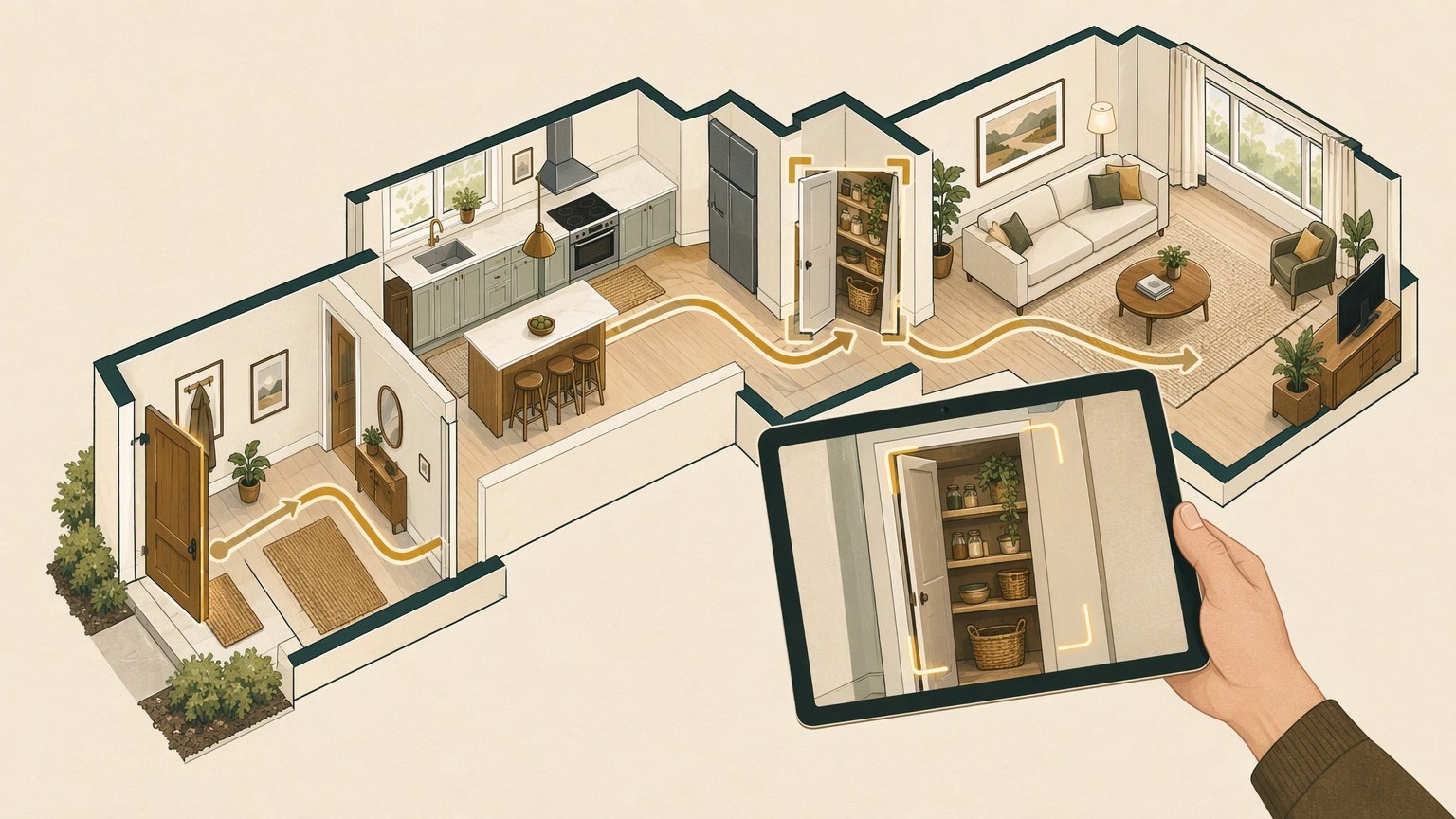
Illustration of a home cutaway with a gold walkthrough route and an open cupboard repeated on a handheld tablet screen.
How does power of attorney fit into a remote purchase?
A power of attorney authorizes another person to act on your behalf within the authority the document grants. For a property transaction, the central question is whether that authority covers the intended acts and is accepted by the professionals handling the transaction.
It solves an attendance problem, not an evidence problem. The ability to sign for you does not establish that the seller can transfer the property, that the building is sound, or that the purchase suits your plans.
A qualified independent Mexican legal professional can explain the appropriate form and scope for the transaction. This article is general educational information, not a document template or legal advice for your circumstances.
Scope matters as much as the representative
Authority for a defined purchase differs from authority that extends to broader property dealings. Price discussions, contract signing, receiving documents, and handling money are separate activities; do not assume a document treats them all the same way.
Professional review can address what the representative may do, any limits, duration, and how the authority can be ended. Trust in the person and clarity in the document serve different purposes. Neither replaces the other.
Signing abroad is an acceptance question
A document signed in the United States should not be assumed acceptable merely because it was notarized there. Consular execution and execution before a local notary are routes to discuss with qualified professionals, not interchangeable procedures that this article can approve.
Authentication, an apostille, translation, identity evidence, and delivery of originals are possible questions for that review. Requirements depend on the document and receiving authority. The efficient sequence is to establish the accepted route before preparing and executing paperwork, rather than trying to fix acceptance afterward.
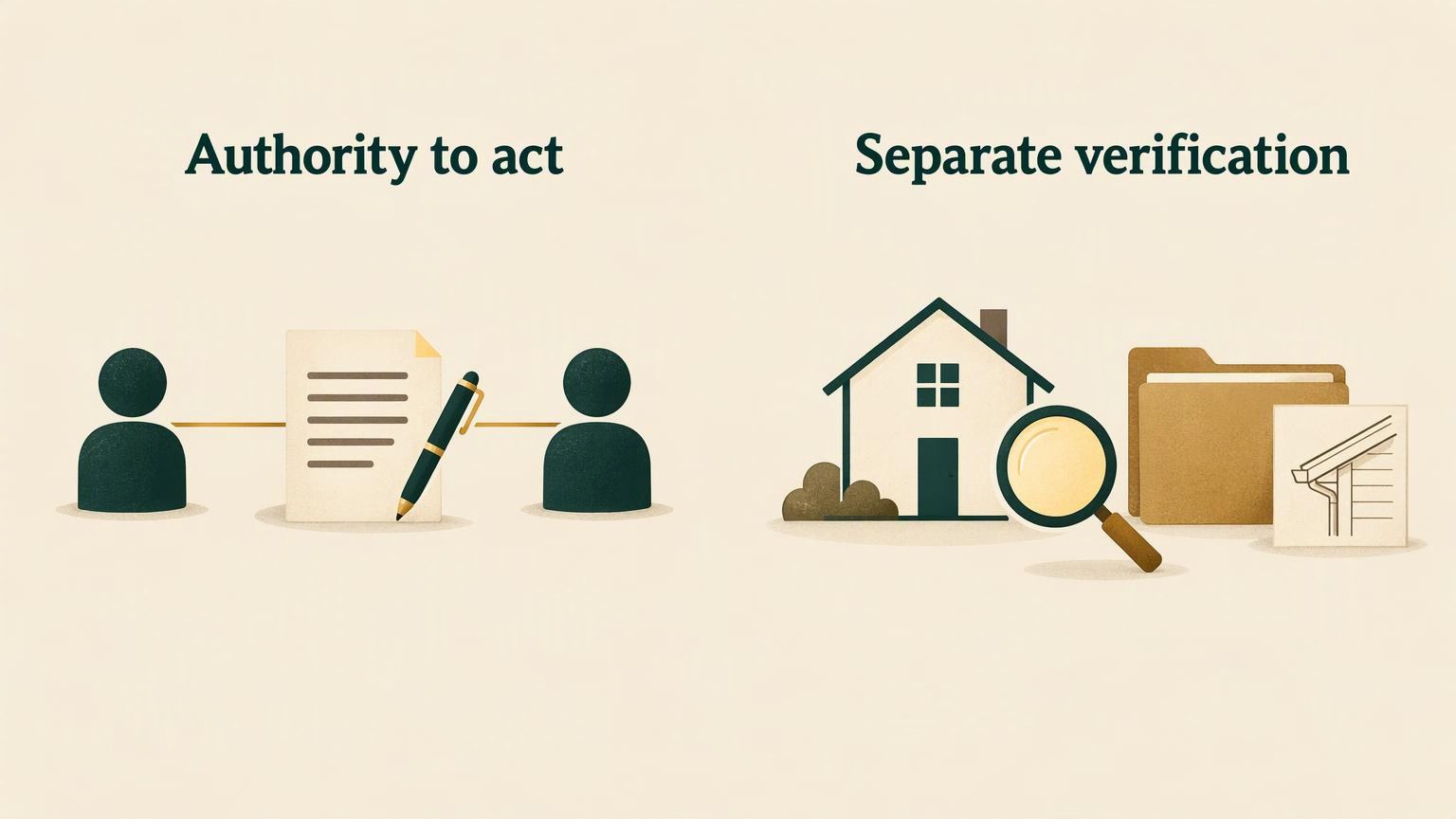
Illustration with two separate groups: linked person icons, a document and pen on the left; a house, magnifying glass, folder and building-detail sketch on the right.
What still needs independent verification on the ground?
Remote buying works better when visual impressions, technical findings, and legal findings remain separate. A property can look suitable while a document question remains open; clean paperwork does not establish that the home feels right for you.
Independent legal review addresses the seller's authority, the rights being transferred, relevant records, and contractual obligations. Independent technical review addresses physical condition within the professional's agreed scope. A representative authorized to sign does not automatically perform either role.
The rights offered also matter. Full ownership, a fractional interest, a timeshare, and land are different products. Their usage rights, continuing fees, and exit terms need separate explanation; a virtual tour of attractive spaces does not identify what you would actually acquire.
Your visit has another purpose: experiencing ordinary life. Consider how the home works for errands, social connection, movement through the building, and time spent outside. The Golden Life's Living Well in Mexico lifestyle guide helps frame that part of the decision without treating a pleasant setting as a substitute for property review.
If you cannot visit, a trusted person's impressions may help, but that person will not have your preferences. A report about access or dimensions answers a narrower question than whether you enjoy living there.
How should you think about sending money from a US bank?
Sending money to Mexico from a US bank is a separate process from viewing the home or authorizing a signature. The transaction needs an established payment arrangement, while your bank has its own transfer procedures. Qualified independent legal and financial professionals can explain the arrangement relevant to the purchase.
A polished email or a familiar name does not verify payment instructions. Any changed instructions deserve independent confirmation through contact details established separately from the message announcing the change.
Useful payment information identifies the recipient, the purpose of the payment, the currency, and how receipt will be documented. The correct recipient depends on the agreed transaction structure; there is no universal account type this article can approve for every purchase.
Exchange rates, bank charges, transfer limits, and processing times require current information from the institutions involved. An advertised purchase amount and the amount needed to complete a cross-border payment are not necessarily identical.
Pressure to transfer before documents or instructions are understood is a reason to pause the discussion and bring it to independent professionals. A completed video viewing is not evidence that a payment request is valid.
When does a visit add more value than remote signing?
Say you are planning to retire in Mexico and like a home after a live walkthrough. The layout seems workable, but you have never spent an ordinary day in the neighborhood and do not know whether the setting fits your routines.
A power of attorney could address your absence at signing, if suitable and accepted. It would not answer the lifestyle question. Visiting before deciding adds information that another signature route cannot provide.
Now picture someone who has already experienced the community and is comfortable with the location, but cannot attend a proposed signing. If independent property review is satisfactory and qualified professionals establish an accepted representative route, remote signing may address the remaining attendance issue.
The difference is not how many calls or documents each person has. It is the question still affecting the decision: 'Would I want to live here?' versus 'How can I participate without attending?'
There is a real downside to each approach. Travel takes effort and still cannot replace professional review. Delegating attendance reduces your direct participation and makes communication with the representative more important. The useful choice addresses the remaining question rather than making the whole process remote by default.
How The Golden Life fits your remote search
The Golden Life begins with your objective: retirement, relocation, a second home, investment, or rental use. That gives property exploration a purpose before a camera tour or listing becomes the focus.
Its process connects your priorities with relevant property information, questions for professional referrals, and a visit-and-verify stage before deciding. Destination and property guidance sits alongside independent due diligence; it does not replace legal, technical, tax, or financial advice.
The downloadable Next-Chapter Planner can support that preparation. Use it to keep your purpose and everyday priorities together while comparing what you can learn remotely with what deserves a visit.
For a viewing-related inquiry, explain whether you want to understand a destination, explore property information, or discuss the next step toward viewing a home. Including what you hope to learn makes the question useful without assuming a specific property or appointment is available.
Current availability, pricing, documentation, and any viewing arrangements require confirmation. An inquiry is the start of a conversation, not a reservation or a promise of a remotely completed purchase.