
Best places to live in Mexico for Americans: Which setting fits your life?

The best places to live in Mexico for Americans depend on the life you want: an arts-centered inland town, a lakeside community, an established Pacific city, a desert-and-sea setting, a Yucatán city or coastal base, or a Caribbean setting. Compare each through climate, neighborhood routines, community, travel access, and personally relevant healthcare needs. No destination is universally best.
Table of Contents
- Compare the neighborhood, not only the destination
- San Miguel de Allende: An arts-centered inland setting
- Ajijic and Lake Chapala: A lakeside community setting
- Puerto Vallarta and Riviera Nayarit: A Pacific setting with different local rhythms
- Los Cabos: Desert landscape, sea, and amenity-led living
- Mérida and the Yucatán coast: Separate city life from coastal life
- Tulum and its surroundings: A Caribbean setting that needs an address-level comparison
- Work through a choice without declaring a winner
- Test the routine before evaluating a property commitment
- Frequently Asked Questions
A useful search for the best places to live in Mexico for Americans starts with an ordinary day, not a postcard. Where will you shop, spend time with friends, pursue an interest, and manage the practical parts of living abroad?
The six settings below are starting points, not a ranking or a complete map of Mexico. Each uses the same criteria, with honest distinctions between destination character and details that depend on an exact address. For the broader planning context, The Golden Life's living and retirement in Mexico hub connects destination choice with the larger move.
Compare the neighborhood, not only the destination
Start by describing the week you want. Someone who wants frequent cultural outings has a different search from someone whose ideal routine revolves around the water, and both differ from a person who values familiar community activities above scenery.
Use the same criteria throughout: seasonal comfort, neighborhood routines, community, travel access, and healthcare access relevant to your needs. A region may satisfy your lifestyle preference while a particular address fails the practical test.
The neighborhood comparison below is general, not a claim about current housing supply in any destination.
| Setting | Potential fit | Trade-off to examine | Useful visit test |
|---|---|---|---|
| Historic central neighborhood | Cultural outings and street-level daily life | Street surfaces, building access, and activity around the home | Walk the routes you would use for errands |
| Residential neighborhood | A routine centered on home and local services | Whether daily needs require transport | Complete an ordinary shopping trip |
| Tourism-oriented area | A stay built around hospitality and leisure amenities | Whether the atmosphere suits everyday living | Spend time there outside your vacation routine |
Use practical needs as filters, not tie-breakers
Family connections, mobility needs, or a particular healthcare requirement may narrow a search more than scenery does. Keep those needs separate from preferences that allow compromise, such as a favorite architectural style or a view.
Healthcare fit requires review with qualified independent medical and insurance professionals. A destination's international appeal does not establish access to a particular clinician, treatment, emergency service, or insurance arrangement.
The week you want to live is a useful starting point for comparing neighborhoods.
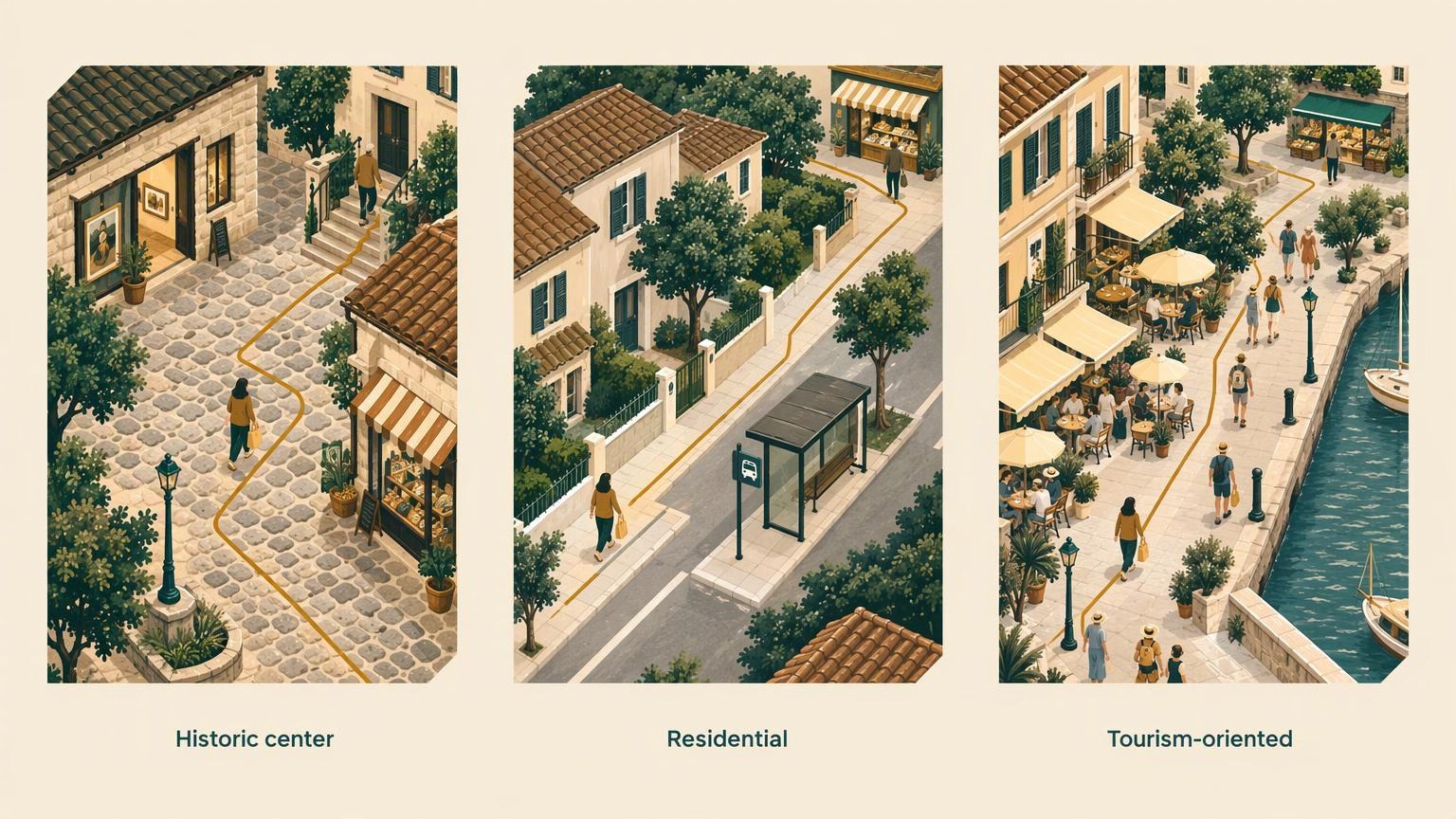
Illustration comparing Historic center, Residential and Tourism-oriented settings, with shopping-bag pedestrians and ochre routes highlighting different street surfaces and activity.
San Miguel de Allende: An arts-centered inland setting
San Miguel de Allende brings historic architecture, galleries, cultural events, and an international community into the comparison. It deserves attention when your imagined routine centers on art, conversation, and town life rather than the beach.
Climate and seasonal comfort: Its inland, higher-altitude setting makes it a different proposition from a tropical coast. Explore comfort during the months you expect to live there, including how the home itself feels throughout the day.
Neighborhood and community: Cobblestone streets and cultural activity are part of its appeal. They also make the exact route between home and daily destinations important, especially when surface conditions or building access affect how comfortably you move around.
Travel and healthcare access: Compare your actual travel itinerary from a candidate address rather than assuming a cultural destination also suits frequent family trips. Personally relevant healthcare access needs independent professional review.
The trade-off: An attractive historic setting does not automatically mean an easy routine. A home that looks appealing in photographs may involve a daily route you would not enjoy.
Does an arts-centered inland routine appeal to you more than life by the water?
Ajijic and Lake Chapala: A lakeside community setting
Ajijic and Lake Chapala bring a lakeside landscape, a mild-climate reputation, and an established English-speaking community into the decision. This setting may suit readers who place social familiarity and a quieter rhythm ahead of an urban or beach-centered life.
Climate and seasonal comfort: Mild weather is part of the area's appeal, but your experience still depends on season, exposure, and the home. Broad destination descriptions cannot tell you whether a particular living space suits your preferences.
Neighborhood and community: Community groups can provide a starting point for connection. The more useful question is whether the activities and people you hope to spend time with are accessible from the neighborhood you are considering.
Travel and healthcare access: Evaluate the journey you would actually make for family visits and essential appointments. English-speaking social connections are not evidence of a particular medical service or insurance arrangement.
The trade-off: A familiar international community may make the setting appealing, but it does not replace your own interests. Choose a routine you would enjoy after the initial novelty of relocation passes.
Puerto Vallarta and Riviera Nayarit: A Pacific setting with different local rhythms
Puerto Vallarta combines a mountain-framed bay with an established international community, neighborhood character, and everyday city services. Those details make it worth exploring when you want coastal scenery alongside a lived-in city rather than a stay defined entirely by resort amenities.
Climate and seasonal comfort: Test coastal living in the season you expect to use the home. Your indoor comfort and willingness to spend time outdoors matter more than how the destination felt on a favorite vacation.
Neighborhood and community: Puerto Vallarta's neighborhood character gives the search more depth than choosing a beach view. Treat Riviera Nayarit as a separate local search within this wider Pacific setting, not as an interchangeable extension of the city.
Travel and healthcare access: Everyday city services are a useful starting point, not proof that every address meets your needs. Compare actual travel arrangements and have relevant healthcare requirements reviewed independently.
The trade-off: Tourism can influence the atmosphere and seasonality of a coastal routine. A neighborhood that suits a leisure stay may feel different when you are managing errands and regular commitments.
Los Cabos: Desert landscape, sea, and amenity-led living
Los Cabos brings a desert landscape and the Sea of Cortez together with marina life, golf, polished amenities, and strong links to the United States. Its appeal is distinct from an inland arts town or a lakeside community.
Climate and seasonal comfort: The desert setting belongs near the start of your comparison. Consider how you want to divide time between outdoor activities and the home during your intended months of residence.
Neighborhood and community: Marina life and golf are concrete lifestyle interests, not universal benefits. If neither is central to your routine, examine what would give your week structure beyond the landscape and hospitality amenities.
Travel and healthcare access: Regional links to the United States are relevant to Americans maintaining family connections. They do not establish a particular route, schedule, or journey from an individual home; healthcare suitability also needs independent review.
The trade-off: Amenities matter only if you use them. A setting organized around activities you rarely pursue may be less suitable than a simpler neighborhood aligned with your ordinary day.
Mérida and the Yucatán coast: Separate city life from coastal life
Mérida's colonial buildings, squares, and cultural life give this setting an urban identity of its own. Including the Yucatán coast in the comparison introduces a different possible routine, but the city and coast should not be treated as one address.
Climate and seasonal comfort: Heat is an important consideration in Mérida. Include indoor comfort and cooling use in your evaluation rather than judging the setting only through outings or photographs.
Neighborhood and community: A city-centered life may revolve around cultural stops, meals, and neighborhood activity. A coastal base needs its own examination of daily services and social opportunities; the city's character cannot simply be transferred to it.
Travel and healthcare access: Assess these from each candidate address. If the appeal depends on regular access to both city and coast, establish the actual journey before treating that combination as practical.
The trade-off: Wanting both city culture and coastal living can leave you choosing between competing routines. Decide which one should be part of an ordinary day and which can remain an occasional outing.
Tulum and its surroundings: A Caribbean setting that needs an address-level comparison
Tulum belongs in a Caribbean-focused search. The wider Riviera Maya has Caribbean coastline, growing residential communities, and international access, but those regional qualities do not describe every home or neighborhood in Tulum and its surroundings.
Climate and seasonal comfort: Treat your intended season of use as part of the lifestyle decision. The relevant test is whether you enjoy your daily routine there, including time indoors, rather than whether you enjoy a beach holiday.
Neighborhood and community: Distinguish the life you want from the destination image that first attracted you. Evaluate where your errands, interests, and social activities would take place instead of assuming that the area's visitor appeal creates an everyday community.
Travel and healthcare access: Regional international access is not an address-specific travel plan. Exact journeys, essential services, and personally relevant healthcare access need their own review.
The trade-off: A Caribbean setting can satisfy a strong landscape preference while leaving practical questions open. Explore those questions before allowing scenery to determine the property search.
| Setting | Lifestyle appeal | What to test |
|---|---|---|
| San Miguel de Allende | Galleries, culture, and town life | Cobblestone routes and building access |
| Ajijic / Lake Chapala | Lakeside, English-speaking community | Access to your preferred activities |
| Puerto Vallarta / Riviera Nayarit | Vallarta: bay and everyday city services | Explore Riviera Nayarit separately |
| Los Cabos | Desert and sea, marina life, golf | Whether you would use the amenities |
| Mérida / Yucatán coast | City culture or a coastal routine | Heat, cooling, and city-coast journeys |
| Tulum / surroundings | Caribbean-focused living | Address-level errands and services |
Work through a choice without declaring a winner
Say you are considering retirement, want regular social contact, enjoy cultural activities, and like the idea of the water. You are not sure whether a beach needs to be part of your daily routine or simply somewhere you enjoy visiting.
San Miguel de Allende deserves consideration if galleries and cultural events are the activities you would build your week around. Ajijic and Lake Chapala deserve consideration if lakeside surroundings and an established English-speaking community better match your preferred pace.
Puerto Vallarta deserves consideration if the bay and coastal life remain central, but you also want neighborhood character and everyday city services. The useful comparison is not which place is more popular; it is which one puts your recurring interests into ordinary life.
If cultural participation matters most, the inland arts setting follows from that priority. If a coastal routine matters most, the Pacific setting becomes more relevant, subject to address-level access and seasonal comfort.
The Golden Life begins with lifestyle priorities before evaluating destination and property direction. Its Find your place lets you share your priorities and send an inquiry.
Test the routine before evaluating a property commitment
A useful exploratory stay includes ordinary tasks as well as leisure. Shop for the things you normally buy, walk the routes you expect to use, and spend time in the neighborhood when you would normally be at home.
Compare the same tasks across your shortlist. Note what you enjoyed, what required extra effort, and whether the experience depended on being on vacation rather than living a normal week.
Keep destination fit separate from property rights, ongoing costs, and technical condition. Full ownership, fractional participation, timeshare, and land are different products; a shared lifestyle description does not make their rights, use, fees, or exit arrangements equivalent.
This article is general educational information, not professional advice. Material facts require independent verification, and personal legal, tax, immigration, financial, medical, and insurance questions belong with appropriately qualified independent professionals.

Illustration of a neighborhood pause after shopping: one adult writes in a notebook while another watches the street, with groceries and a separate closed folder on the cafe table.